The End of Memorization: Assessment in the Age of AI
I have some bad news. The “Fill in the Blanks” question is dead. The “Write a short essay on Cows” assignment is dead.
ChatGPT killed them.
In 2025, if you give a homework assignment that can be solved by typing it into a chatbot, you are not testing the student’s knowledge. You are testing their ability to copy-paste.
The “Googleable” Test
For decades, Nepali education has been about Memory.
- “What is the capital of France?”
- “Define Photosynthesis.”
- “List the 8 planets.”
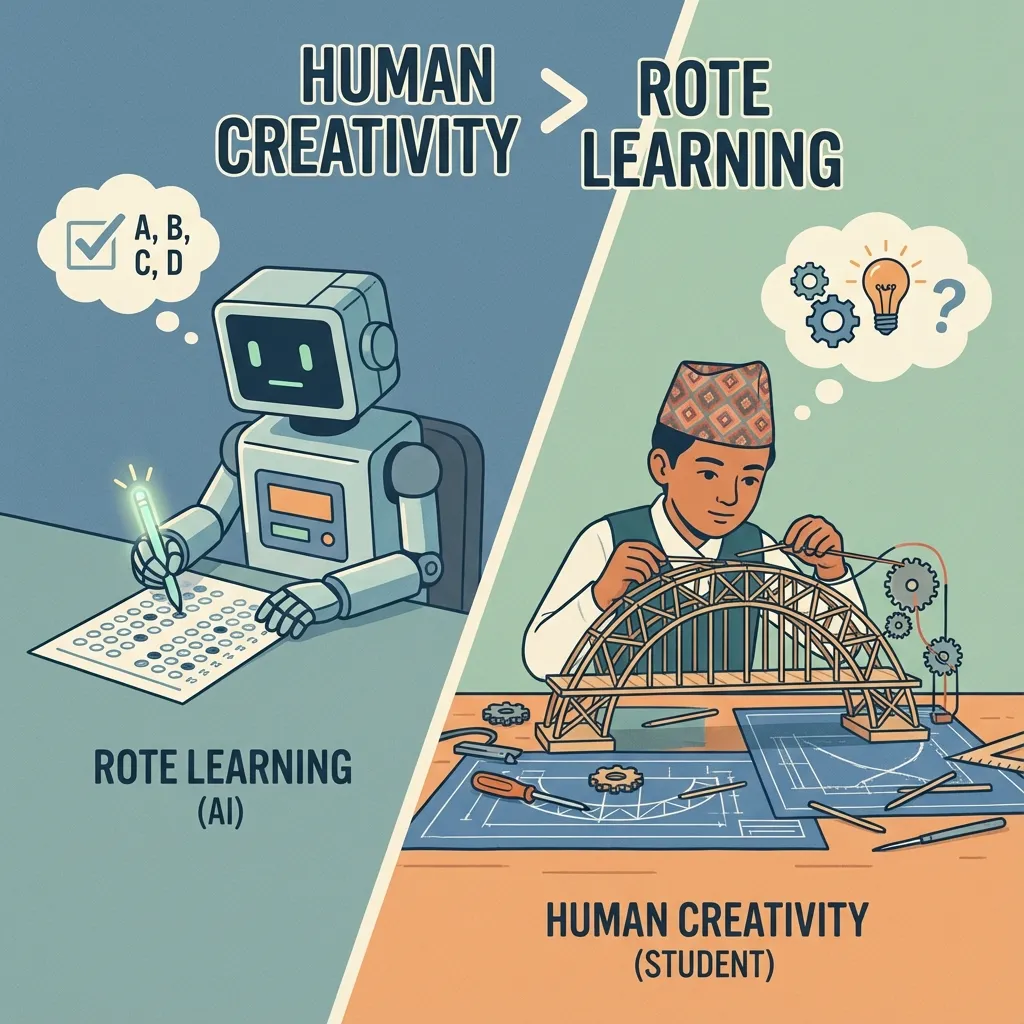
These are facts. Computers are better at facts than we are. If we keep training students to be “Answer Machines,” we are training them to be replaced by robots.
The New Assessment Model: “Process over Product”
As a Teacher Developer, I don’t grade the final answer. I grade the path they took to get there.
Instead of:
“Write an essay on Climate Change.” (AI can do this in 5 seconds).
Ask:
“Here is an AI-generated essay on Climate Change that contains 3 factual errors. Find the errors and rewrite the essay to be correct.”
Why this works: To find the errors, the student must actually understand the topic. They have to play “Editor” instead of “Writer.”
Instead of:
“Solve this Math problem.”
Ask:
“Record a 1-minute video explaining how you solved this Math problem to a 5-year-old.”
Why this works: AI can generate the number. But it cannot replicate the student’s unique voice and explanation style (yet).
The Human Advantage
We need to stop fearing that AI will help students “cheat.” Instead, we should create assessments where cheating is impossible because the answer requires personal experience, local context, and creativity.
Ask them to interview their grandmother. Ask them to build a bamboo bridge. Ask them to design a business plan for their village.
Let the robots handle the memorization. Let the students handle the thinking.
Related Posts and Resources
- Low-Tech, High-Impact Teaching in Nepal
- Coding for Teachers in Nepal
- Data-Driven Grading for Educators
- Open-Source Schools in Nepal
- Gamification in Nepali Classrooms
- Cyber Hygiene for Students and Teachers
- Flipped Classroom in Nepal
- CS Unplugged Activities in Nepal
- School Wi-Fi Budget Planning
- Digital Marketing in Nepal (Complete Guide)