How to Price Digital Marketing Services: Agency Pricing Models Explained

Pricing is where most agency businesses fail before they start.
Undercharge, and you build a business that demands your full capacity for below-market returns. Overcharge without the positioning to back it up, and you do not get the clients you need to build that positioning.
The agency owners who build durable, profitable businesses are not those with the best delivery skills. They are those who figure out pricing early, price confidently, and raise their rates consistently.
This guide covers every pricing model used by digital marketing agencies in 2026 — with real rate benchmarks, the math behind each model, and how to evolve your pricing as your agency grows.
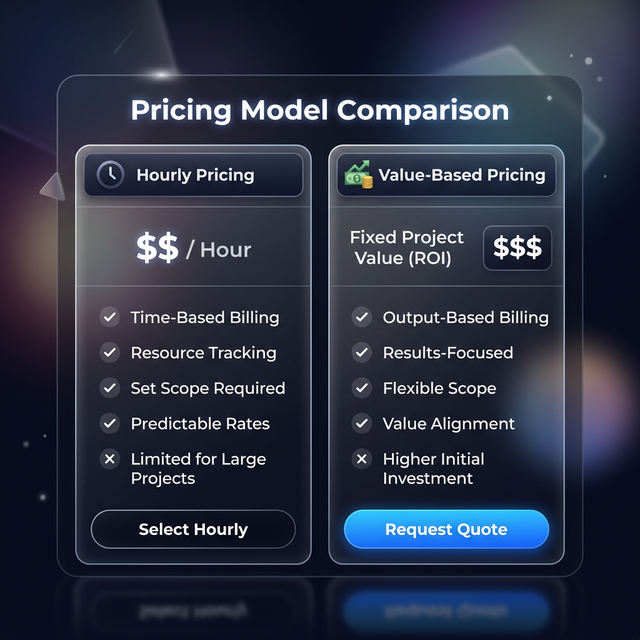
Table of Contents
- The Five Agency Pricing Models
- Hourly Billing: When It Works and When It Doesn’t
- Project Pricing: One-Time Fees Done Right
- Monthly Retainers: The Agency Revenue Engine
- Value-Based Pricing: The Most Profitable Model
- Performance Pricing: Revenue Share and Pay-Per-Lead
- Rate Benchmarks by Service Type
- Packaging Your Services for Higher Average Contract Value
- How to Raise Your Prices Without Losing Clients
The Five Agency Pricing Models
| Model | How You Charge | When to Use | Profitability |
|---|---|---|---|
| Hourly | Per hour worked | Audits, consulting, early-stage | Low ceiling |
| Project | Fixed fee per deliverable | Websites, strategy docs, campaigns | Medium |
| Monthly retainer | Fixed monthly fee | Ongoing service delivery | High |
| Value-based | Based on business value generated | Strong client relationships | Highest |
| Performance | % of revenue or per lead | High trust, transparent clients | Variable |
Most mature agencies use a retainer-dominant model with project fees for onboarding and value-based framing in sales conversations.
Hourly Billing: When It Works and When It Doesn’t
Hourly billing is the default model for many freelancers and new agencies. It feels fair — you charge for the time you spend.
The problem: hourly billing creates a ceiling on your income, rewards inefficiency, and puts the client in the position of scrutinizing every hour on your invoice.
As you get faster and better at your work — two things that should happen over time and should benefit you — hourly billing gives the reward to the client, not you.
Where Hourly Billing Does Make Sense
Strategy and consulting calls — When a client needs your brain for 2 hours, hourly billing is appropriate. This is consulting, not service delivery.
Audits and one-time analysis — A technical SEO audit, Google Ads account audit, or content strategy audit with undefined scope is difficult to scope as a project. Hourly billing protects you from audit scope that expands indefinitely.
Ad hoc overflow work — Existing clients who want work outside their retainer scope can be billed at your hourly rate for the additional work.
Agency Hourly Rate Benchmarks (2026)
| Service | Junior | Mid-Level | Senior |
|---|---|---|---|
| General marketing consulting | $75/hr | $125/hr | $200/hr |
| SEO strategy | $85/hr | $150/hr | $225/hr |
| Google Ads management | $75/hr | $125/hr | $175/hr |
| Content strategy | $65/hr | $110/hr | $175/hr |
| Email marketing | $60/hr | $100/hr | $160/hr |
| Social media strategy | $55/hr | $90/hr | $150/hr |
These are USA/UK market rates. For markets with lower purchasing power, rates are typically 40–60% of these figures.
Project Pricing: One-Time Fees Done Right
Project pricing charges a fixed fee for a defined deliverable: a website, a campaign launch, an SEO audit, a content strategy document, a social media setup.
Project pricing works well when:
- The scope is clearly defined and unlikely to expand
- The deliverable has a clear endpoint
- The client wants to see results before committing to ongoing work
Common Agency Project Fees
| Project | Price Range | What’s Included |
|---|---|---|
| SEO audit | $750–$3,500 | Technical, on-page, link profile, recommendations |
| Website content (5 pages) | $1,500–$5,000 | Homepage, about, services, blog setup, contact |
| Google Ads setup | $750–$2,500 | Account structure, campaigns, ad copy, conversion tracking |
| Social media setup | $500–$2,000 | Profile optimization, content calendar, templates |
| Email sequence (5 emails) | $750–$2,500 | Copywriting, automation setup in platform |
| Content strategy | $1,500–$4,000 | Keyword research, content calendar, brief templates |
| Brand voice guide | $1,000–$3,000 | Voice document, tone examples, messaging hierarchy |
| Landing page | $750–$2,500 | Copywriting, design brief, A/B variant |
Project Scoping to Prevent Scope Creep
Every project proposal needs:
- Defined deliverables — exactly what will be produced
- Revision rounds — typically 2 rounds included; additional rounds at $X/hour
- Timeline — start date, milestone dates, completion date
- Client responsibilities — what the client must provide (brand assets, access, feedback deadlines)
- Out-of-scope clause — explicit statement that work beyond the defined scope is billed separately
The most common project billing problem is scope creep — clients adding requests beyond the original brief without corresponding additional payment. A clear contract and an explicit scope definition prevents 90% of these conflicts.
Monthly Retainers: The Agency Revenue Engine
Monthly retainers are the foundation of a profitable agency business. They create predictable recurring revenue, simplify your financial planning, and allow you to build deeper expertise in each client’s business.
A $3,000/month retainer retained for 18 months is worth $54,000 in revenue from a single client relationship. The cost of signing that client is paid once; the recurring revenue compounds over the relationship.
How to Structure a Monthly Retainer
A retainer is not “X hours of your time per month.” That is hourly billing with a monthly billing cycle — not a true retainer.
A proper retainer is:
- A defined scope of ongoing services
- A fixed monthly fee regardless of hours
- A clear set of deliverables each month
- Performance reporting tied to agreed KPIs
Retainer Contract Terms That Protect Your Agency
Minimum commitment — 3-month minimum is standard for most agencies. Some require 6 or 12 months for service lines with longer result timelines (SEO, content marketing). Month-to-month retainers are appropriate for clients who are a high churn risk or for agencies still proving their model.
Payment in advance — Charge on the 1st of each month for services delivered that month. Never work in arrears — agencies that bill at end of month after delivering work expose themselves to non-payment risk and cash flow problems.
30-day cancellation notice — Require written cancellation notice 30 days before the final service month. This gives you time to find a replacement client before the revenue gap opens.
Scope increase clause — Specify clearly that requests outside the defined scope are billed at your hourly consulting rate. Without this, clients will expand scope incrementally without understanding they are increasing cost.
Value-Based Pricing: The Most Profitable Model
Value-based pricing is the most profitable model available to agencies — and the hardest to implement without strong positioning and sales confidence.
The premise: your price is not about your costs or your hours. It is about the value your service creates for the client.
The Value Calculation
If your SEO campaign for a B2B software company:
- Increases organic traffic by 200 visits/month
- Converts at 2% (4 additional leads/month)
- Closes at 25% (1 additional customer/month)
- With an average contract value of $12,000
Your work generates $12,000/month in new revenue. A $3,000–4,000/month retainer represents 25–33% of the revenue you create — a clear ROI case that most clients will immediately understand.
Value-based pricing conversations start not with “here is what we do” but with “what is a new customer worth to you?”
When Value-Based Pricing Works
- You have documented case studies showing attributable revenue impact
- You work with clients in industries where revenue per customer is high (B2B SaaS, professional services, e-commerce)
- You can clearly attribute a meaningful portion of client revenue to your work
- The client is revenue-focused, not task-focused (they evaluate you on outcomes, not activity)
When to Avoid Value-Based Pricing
- Clients that micro-manage deliverables rather than outcomes
- Industries where revenue attribution is difficult (brand marketing, PR)
- Early-stage agencies without documented case studies to support the premium
Performance Pricing: Revenue Share and Pay-Per-Lead
Performance pricing ties your fee to measurable business outcomes — leads generated, revenue produced, or sales closed.
This model aligns incentives: if you produce results, you earn more; if you do not, you earn less. It sounds appealing on both sides.
In practice, performance pricing creates problems:
Agency risk: You control ad copy and targeting, but not the client’s sales team, response time, pricing, or product quality. All of these affect conversion and revenue — factors outside your control but inside your P&L.
Attribution disputes: Who gets credit for a lead? The SEO content that surfaced it, the Google Ad that captured it, or the email sequence that nurtured it? Multi-channel attribution creates billing ambiguity.
Timing mismatches: You invest time and resources in month one when revenue is zero. Performance fees arrive in months 3–6 when results compound.
Where Performance Pricing Works
- Pay-per-lead campaigns with local service businesses (HVAC, roofing, legal) where lead quality and volume are easily tracked
- Revenue share with e-commerce clients when the agency controls the full funnel (website, ads, email)
- Bonus structures layered onto a base retainer (base retainer + bonus above agreed KPI thresholds)
The most sustainable version of performance pricing is a hybrid: a base retainer that covers your costs and core services, plus a performance bonus when defined KPIs are exceeded.
Rate Benchmarks by Service Type (2026)
SEO Agency Pricing
| Package | Monthly Fee | What’s Included |
|---|---|---|
| Local SEO | $750–$1,500 | GMB optimization, local citations, basic on-page |
| Content SEO | $1,500–$3,500 | Keyword research, 4–8 blog posts, on-page optimization |
| Technical SEO | $1,200–$4,000 | Crawl issues, Core Web Vitals, schema, site speed |
| Full-Service SEO | $2,500–$8,000 | Content + technical + link building + strategy |
| Enterprise SEO | $8,000–$25,000+ | Large site management, multi-locale, dedicated team |
Paid Advertising Pricing
| Service | Pricing Model | Typical Range |
|---|---|---|
| Google Search Ads | 15% of ad spend + $500 min | $500–$3,500/month |
| Meta (Facebook/Instagram) Ads | 15% of ad spend + $500 min | $500–$3,000/month |
| Google + Meta Combined | 12% of ad spend + $750 min | $750–$5,000/month |
| YouTube Ads | 15–20% of ad spend | $1,000–$5,000/month |
| LinkedIn Ads (B2B) | 15–20% of ad spend | $1,500–$6,000/month |
Social Media Management Pricing
| Scope | Monthly Fee | Platforms | Posts/Month |
|---|---|---|---|
| Basic | $600–$1,000 | 1–2 platforms | 12–16 posts |
| Standard | $1,000–$2,000 | 2–3 platforms | 20–30 posts |
| Full management | $2,000–$4,000 | 3–5 platforms | 30–60 posts |
| Agency white-label | $400–$800 | 1 platform | 12–20 posts |
Content Marketing Pricing
| Package | Monthly Fee | Output |
|---|---|---|
| Blog only | $800–$2,000 | 4–8 blog posts |
| Blog + social | $1,500–$3,500 | 4–8 posts + social captions |
| Full content program | $3,000–$8,000 | Blog + social + email + video scripts |
| Content strategy only | $1,500–$4,000 one-time | Strategy doc + editorial calendar |
Packaging Your Services for Higher Contract Value
Most agency owners sell services one at a time. The most profitable agencies package complementary services into bundles that deliver more value and generate higher average contract value.
The Tiered Package Approach
Present every prospect with three options: entry, core, and premium. Research consistently shows that when given three options, the majority of buyers choose the middle one — and a meaningful percentage choose premium.
Example: Full-Service Digital Marketing Agency
Starter — $1,500/month
- 4 blog posts (SEO-optimized)
- Social posting (3 times/week, 1 platform)
- Monthly performance report
Growth — $3,000/month (Most Popular)
- 8 blog posts (SEO-optimized)
- Social posting (5/week, 2 platforms)
- Email newsletter (2/month)
- Google Ads management (up to $3,000 ad spend)
- Bi-weekly strategy call
- Monthly performance report
Scale — $6,000/month
- 16 blog posts (SEO-optimized)
- Social posting (daily, 3 platforms)
- Email marketing (4 campaigns/month + automation)
- Google + Meta Ads management (up to $10,000 ad spend)
- Weekly strategy call
- Dedicated account manager
This structure anchors the conversation at $6,000 and makes $3,000 feel like the reasonable, risk-managed choice.
How to Raise Your Prices Without Losing Clients
Agencies that do not raise prices lose margin every year as costs increase. The goal is incremental, justified price increases that clients accept because the value is evident.
The Price Increase Protocol
Step 1: Define the increase and rationale. A 15–20% increase is standard for annual reviews. Be specific about why: market rate alignment, expanded service scope, increased tool costs, team capacity increases.
Step 2: Give adequate notice. 30–60 days advance notice is standard. 60 days for significant increases ($500+/month).
Step 3: Frame around value, not cost. Do not say “our costs have gone up.” Say “based on the results we have delivered this year [reference specific wins], we are adjusting our pricing to be in line with the value we are creating.”
Step 4: Offer a grandfathering option for long-term loyal clients. Clients who have been with you 24+ months can be offered a reduced increase (10% instead of 20%) as a loyalty acknowledgment. This retains your most stable revenue while still moving rates up.
Step 5: Accept that some clients will leave. A 10–15% churn rate from a price increase is normal. The remaining clients at higher rates often generate more revenue than the churned clients generated before the increase.