Learning Objectives
By the end of this chapter, you will be able to:
- Define Big Data and understand why it requires specialized technologies.
- Describe the Five V’s that characterize Big Data (Volume, Velocity, Variety, Veracity, Value).
- Differentiate between structured, unstructured, and semi-structured data.
- Identify common sources and technologies associated with Big Data.
What is Big Data?
Big Data refers to the vast and complex datasets that are too large to be effectively managed or analyzed using traditional data processing tools, such as relational databases. The challenge of Big Data is not just about storage; it’s about the ability to capture, process, analyze, and derive meaningful insights from these massive datasets in a timely manner.
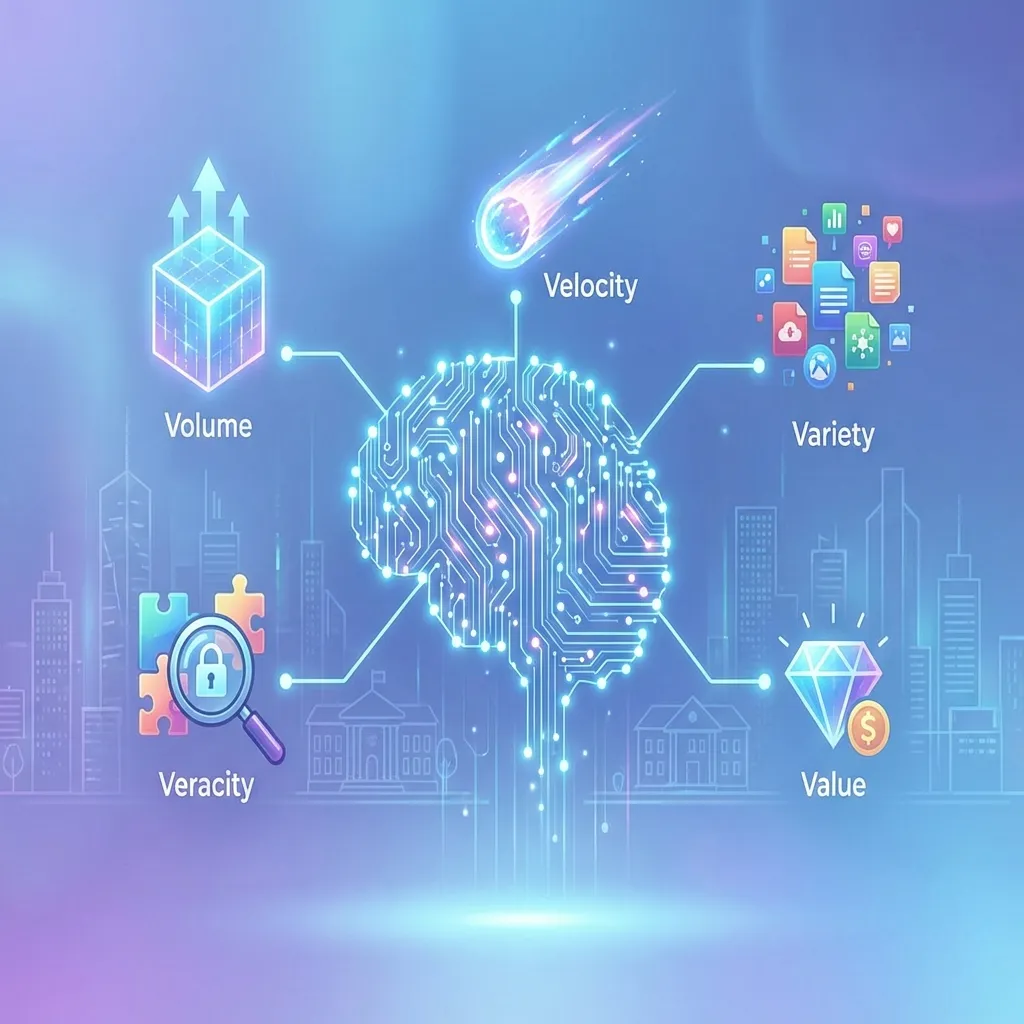 Figure 1: Understanding Big Data
Big Data is often characterized by the Five V’s:
mindmap
  root((Big Data\n5 V's))
    Volume
      Petabytes
      Exabytes
      Massive Scale
    Velocity
      Real-time
      Streaming
      High Speed
    Variety
      Structured
      Unstructured
      Semi-structured
    Veracity
      Quality
      Accuracy
      Trustworthiness
    Value
      Business Insights
      Competitive Edge
      ROI
Figure 2: The Five V’s of Big Data
1. Volume
This refers to the sheer scale of the data being generated. We have moved from measuring data in gigabytes and terabytes to petabytes and exabytes. This enormous volume presents a significant storage challenge and requires distributed systems to manage.
- Example: The Large Hadron Collider at CERN generates about 1 petabyte of data per second. Facebook stores hundreds of petabytes of user photos and videos.
2. Velocity
Velocity is the speed at which new data is generated and the pace at which it must be processed. In many applications, real-time or near-real-time analysis is necessary to extract value.
- Example: Stock market data, social media feeds, and data from IoT sensors on a factory floor are all generated at extremely high velocity and require immediate processing to be useful.
3. Variety
This refers to the different forms that data can take. While traditional data is typically structured (e.g., neatly organized in the rows and columns of a relational database), Big Data is often unstructured or semi-structured.
flowchart LR
    subgraph TYPES["Data Types"]
        STRUCT["📊 STRUCTURED\nDatabases, Spreadsheets\nRows & Columns"]
        SEMI["📝 SEMI-STRUCTURED\nJSON, XML\nTags & Markers"]
        UNSTRUCT["🎥 UNSTRUCTURED\nText, Images, Video\nNo Fixed Format"]
    end

    STRUCT --> |"~20%"| BIGDATA[("🌐 Big Data")]
    SEMI --> |"~10%"| BIGDATA
    UNSTRUCT --> |"~70%"| BIGDATA

    style BIGDATA fill:#6a1b9a,color:#fff
Figure 3: Types of Data in Big Data
- Structured Data: Highly organized and easily searchable (e.g., a customer database).
- Unstructured Data: Has no predefined format or organization (e.g., text in emails, social media posts, images, videos, audio files).
- Semi-structured Data: Does not conform to the strict structure of a relational database but contains tags or markers to separate semantic elements (e.g., XML or JSON files).
4. Veracity
Veracity refers to the trustworthiness, quality, and accuracy of the data. With such a large volume and variety of data coming from different sources, there is often a great deal of uncertainty and imprecision. Ensuring data veracity is a major challenge, as poor-quality data can lead to inaccurate analysis and bad decisions.
- Example: Analyzing social media sentiment can be difficult due to the presence of sarcasm, slang, and fake accounts, which affects the veracity of the data.
5. Value
This is arguably the most important V. Value refers to the potential of the data to be turned into a tangible business outcome. The ultimate goal of collecting and analyzing Big Data is to derive insights that can lead to better decisions, improved business processes, and a competitive advantage. If the data cannot be used to create value, then it is just a costly storage problem.
Sources and Technologies
Big Data comes from numerous sources, including:
- Web logs and social media
- Internet of Things (IoT) sensors
- GPS and location data
- Multimedia files
Managing Big Data requires specialized technologies beyond traditional relational databases. These include frameworks like Apache Hadoop for distributed storage and processing, and NoSQL databases (e.g., MongoDB, Cassandra) which are designed to handle unstructured data at scale.
Summary
Big Data is characterized by its massive Volume, high Velocity, and wide Variety. The challenges of ensuring its Veracity (quality) and extracting business Value make it a complex but powerful asset. Unlike traditional, structured data, Big Data is often unstructured and requires specialized technologies like Hadoop and NoSQL databases to be managed and analyzed effectively.
Key Takeaways
- Big Data is defined by the Five V’s: Volume, Velocity, Variety, Veracity, and Value.
- Most Big Data is unstructured (e.g., text, images, video), unlike traditional structured data.
- The ultimate goal of Big Data is to extract value and drive business outcomes.
- Specialized tools are required to handle the scale and complexity of Big Data.
Discussion Questions
- Why can’t a traditional relational database handle the challenges of Big Data?
- Of the Five V’s, which do you think is the most difficult for a business to manage and why?
- Provide an example of how a company could derive value from analyzing unstructured data.