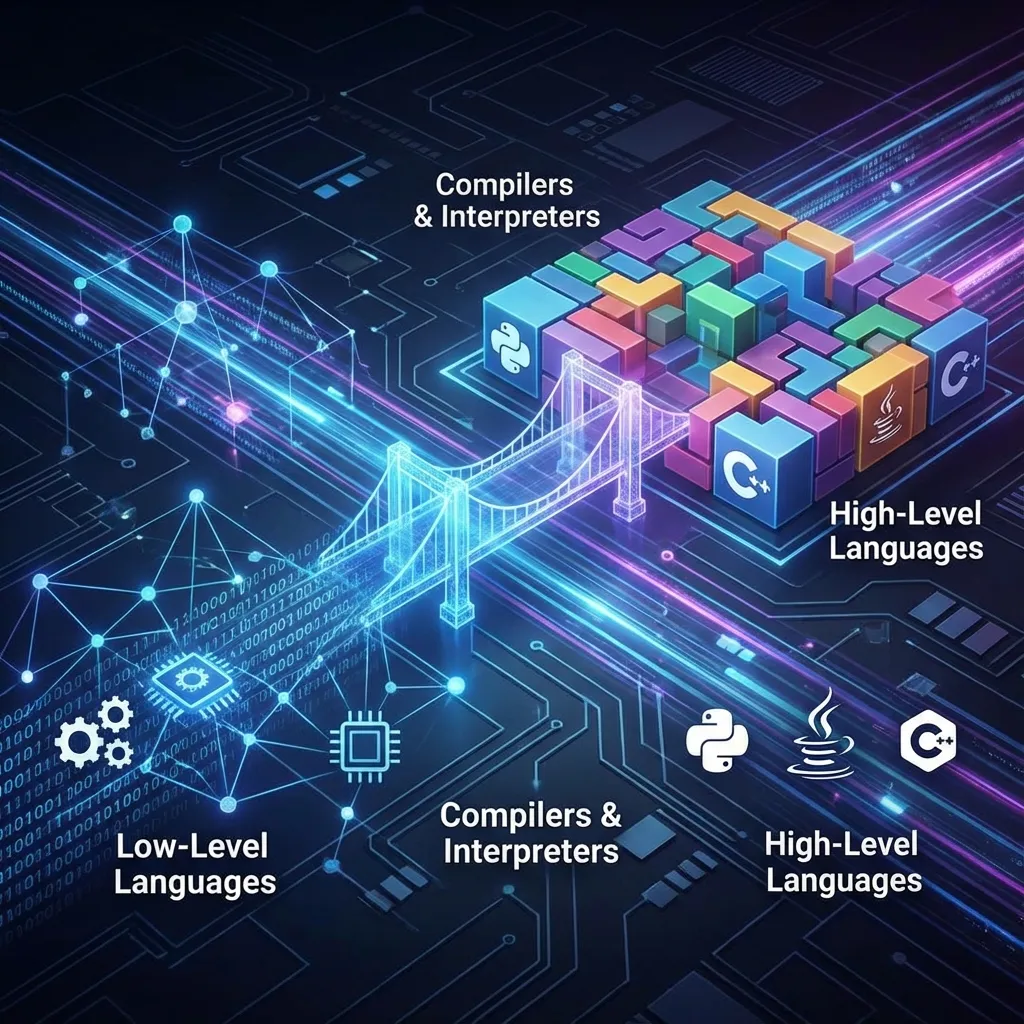
Learning Objectives
By the end of this chapter, you will be able to:
- Define a programming language.
- Differentiate between low-level and high-level programming languages.
- Describe the generations of programming languages.
- Understand the role of a compiler and an interpreter.
- Identify common languages and their typical uses.
What is a Programming Language?
A programming language is a formal language comprising a set of instructions that produce various kinds of output. Programming languages are used in computer programming to implement algorithms.
Most programming languages consist of instructions for computers. There are programmable machines that use a set of specific instructions, rather than general programming languages.
Every language has syntax (the rules for writing statements correctly, like grammar) and semantics (what the statements mean). A program with a syntax error will not run; a program with a logic error runs but gives wrong results.
Low-Level vs. High-Level Languages
Programming languages can be broadly categorized into two types: low-level and high-level.
Low-Level Languages
Low-level languages are closer to the computer’s native machine code and provide little to no abstraction from the hardware.
- Machine Language: The lowest-level language, consisting of binary code (0s and 1s) that the CPU can directly execute. It is not human-readable.
- Assembly Language: A step above machine language, assembly uses mnemonics (short, human-readable words) to represent machine-level instructions. It must be converted to machine code by an assembler.
High-Level Languages
High-level languages are closer to human language and provide a high degree of abstraction from the hardware. They are designed to be easy for humans to read, write, and maintain.
- Characteristics: Use English-like syntax, are easier to learn, and are more portable across different computer architectures.
- Examples: Python, Java, C++, C#, JavaScript, and Ruby.
flowchart TB
    HL[High-Level Languages<br/>Python, Java, C++]
    ASM[Assembly Language]
    ML[Machine Language<br/>Binary 0s and 1s]
    HL -->|Compiler or Interpreter| ML
    ASM -->|Assembler| ML
Figure 1: Programming Language Levels
The same task at different levels
Adding two numbers:
| Level | Example code |
|---|---|
| Machine language | 10110000 00000101 (binary instructions) |
| Assembly language | MOV AL, 5 then ADD AL, 3 |
| High-level (Python) | total = 5 + 3 |
| Aspect | Low-level languages | High-level languages |
|---|---|---|
| Readability | Hard for humans | Easy, English-like |
| Speed of program | Very fast, efficient | Slightly slower (depends on translator) |
| Portability | Tied to one CPU type | Runs on many machines |
| Development time | Long; error-prone | Short; easier to debug and maintain |
| Use | Device drivers, embedded systems | Business apps, websites, data analysis |
Generations of Programming Languages
| Generation | Type | Example |
|---|---|---|
| 1GL | Machine language | Binary code |
| 2GL | Assembly language | MOV, ADD mnemonics |
| 3GL | Procedural high-level languages | C, Java, Python, COBOL |
| 4GL | Closer to human language; say what, not how | SQL, report generators |
| 5GL | Problem solving with constraints and AI | Prolog |
For example, in SQL (a 4GL) a manager writes SELECT Name FROM Customers WHERE City = 'Pokhara'; without describing step by step how to search the data.
Compilers and Interpreters
Since computers can only understand machine code, high-level languages must be translated. This is done by either a compiler or an interpreter.
- Compiler: A compiler translates the entire source code of a program into machine code before the program is run. The resulting machine code is then saved as an executable file that can be run at any time.
- Process: Source Code -> Compiler -> Machine Code (Executable File)
- Examples: C and C++ are typically compiled languages.
- Interpreter: An interpreter translates and executes the source code line by line, at the same time. No separate executable file is created.
- Process: Source Code -> Interpreter -> Execution (line by line)
- Examples: Python and JavaScript are typically interpreted languages.
flowchart LR
    SRC[Source Code]
    SRC -->|Compiler| EXE[Machine Code Executable]
    EXE --> RUN1[Run Program]
    SRC -->|Interpreter| RUN2[Execute Line by Line]
Figure 2: Compile vs Interpret Flow
| Aspect | Compiler | Interpreter |
|---|---|---|
| Translation | Whole program at once | Line by line |
| Output | Executable file | No separate file |
| Execution speed | Faster once compiled | Slower |
| Error reporting | Lists errors after compiling the whole program | Stops at the first error |
| Example languages | C, C++ | Python, JavaScript |
Java uses both: it is compiled to an intermediate bytecode, which the Java Virtual Machine then runs on any device.
Popular Languages and Their Uses
| Language | Typical use |
|---|---|
| Python | Data analysis, AI, automation, web back ends |
| JavaScript | Interactive websites and web apps |
| Java | Enterprise systems, Android apps, banking software |
| C / C++ | Operating systems, games, embedded devices |
| C# | Windows applications, games (Unity) |
| PHP | Websites (e.g., WordPress) |
| SQL | Querying and managing databases |
| Kotlin / Swift | Android / iOS mobile apps |
Choosing a language
Factors include the type of application (web, mobile, data), performance needs, availability of developers and libraries, cost and support, and compatibility with existing systems. A Nepali software company building a bank’s mobile app might use Kotlin and Swift for the apps, Java for the back end, and SQL for the database.
Summary
Programming languages are the tools we use to give instructions to computers. They range from low-level languages like machine and assembly language, which are close to the hardware, to high-level languages like Python and Java, which are closer to human language, and they have developed through five generations up to 4GLs such as SQL and 5GLs. High-level languages must be translated into machine code by either a compiler (which translates the whole program at once) or an interpreter (which translates it line by line) before the computer can execute them. Different languages suit different purposes, from websites to data analysis to mobile apps.
Key Takeaways
- Programming languages are used to write instructions for computers.
- Low-level languages (machine, assembly) are close to the hardware, while high-level languages (Python, Java) are closer to human language.
- Languages have evolved through five generations, from machine code to AI-oriented languages.
- Compilers translate the entire program at once, while interpreters translate it line by line.
- The choice of language depends on the application, performance, skills, and cost.
Discussion Questions
- What are the main advantages of using a high-level language over a low-level language?
- What is the difference between a compiler and an interpreter?
- If you were creating a new software application, what factors would you consider when choosing a programming language?
Exam-Style Questions
Short answer
- What is a programming language? Differentiate between syntax and logic errors.
- What is assembly language? What is an assembler?
- Differentiate between a compiler and an interpreter.
Long answer
- Compare low-level and high-level languages with examples.
- Explain the generations of programming languages.


