Top Personal Injury Lawyers in New York: How to Choose
Disclaimer: This article is general information, not legal advice. arjankc.com.np is not a law firm, does not recommend or rank specific lawyers, and does not receive referral fees. Laws change; speak to a licensed New York attorney about your situation.
Last reviewed: 13 October 2026
People searching for the “top” personal injury lawyers in New York usually want one thing: a lawyer who will get them a fair result. There is no official ranking of personal injury lawyers, and many “best lawyer” lists are paid placements or self-nominated. A better approach is to check every candidate against the same objective standards. This guide explains how.
Step 1: Confirm the lawyer is licensed and in good standing
The official record of New York attorneys is kept by the Office of Court Administration. Use the Attorney Search on the New York courts’ legal professional page to confirm the lawyer is registered. The New York State Bar Association says it is not the official bar and cannot verify licences; certificates of good standing come from the Appellate Division where the lawyer was admitted (NYSBA).


The New York State Supreme Courthouse, 60 Centre Street, Manhattan. Photo: Beyond My Ken, CC BY-SA 4.0, via Wikimedia Commons.

Step 2: Match experience to your type of case
“Personal injury” covers very different cases: car and truck crashes, construction site injuries, slip-and-falls, medical malpractice and wrongful death. Ask each lawyer:
- How many cases like mine have you handled in the last few years?
- How many went to trial rather than settling?
- Who will actually work on my case day to day — you, an associate or a paralegal?
- Do you have the resources to hire experts if my case needs them?
Past results do not guarantee future outcomes. A lawyer who promises a specific amount before reviewing your records is a warning sign.
Step 3: Understand New York contingency fees
Most personal injury lawyers work on a contingency fee: they are paid a percentage of what you recover and nothing if you recover nothing. New York court rules limit these fees.
- Ordinary personal injury cases. Court rules set a schedule of fees presumed reasonable; fees above it can be treated as unreasonable unless a court approves them. In practice this is commonly one-third of the recovery (22 NYCRR 1015.15; 22 NYCRR 691.20).
- Medical malpractice. State law sets a sliding scale: 30% of the first $250,000, 25% of the next $250,000, 20% of the next $500,000, 15% of the next $250,000 and 10% above $1.25 million (Judiciary Law §474-a).
- Net or gross. Under 22 NYCRR 1015.15, the agreement must explain whether the percentage is taken before or after case expenses (such as expert fees) are deducted, explain the financial effect of each, and record your choice. The difference can be significant, so ask for an example calculation.
- Liens are not deducted first. The rules say the percentage is not reduced for hospital, medical or insurer liens — those are paid from your share.
Get the fee agreement in writing and read it before signing.
Step 4: Know your deadlines
Missing a deadline can end a claim entirely, so contact a lawyer early. The New York courts’ statute of limitations chart lists the main ones:
| Type of claim | General deadline |
|---|---|
| Car accident or other negligence | 3 years from the accident (CPLR 214) |
| Claim against a city, county, town or school district | Notice of claim within 90 days; lawsuit within 1 year and 90 days (GML §50-e; §50-i) |
| Wrongful death | 2 years from the death (EPTL §5-4.1) |
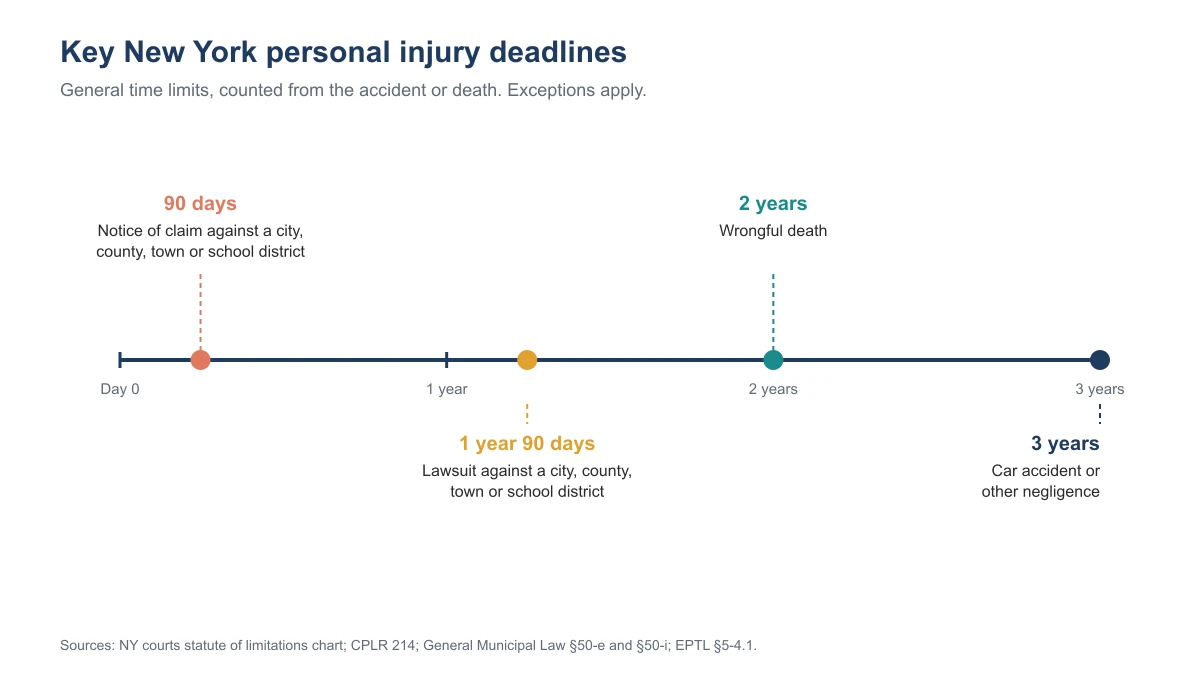
Chart: general deadlines counted from the accident or death. Sources as listed in the table above.
Exceptions apply — for example, for children, certain toxic exposures and medical malpractice — so ask a lawyer which deadline applies to you.
A note on wrongful death: the Grieving Families Act, which would have extended the deadline and allowed recovery for grief, passed the Legislature but was vetoed again in December 2025 (NY Senate S4423). Unless a new law is enacted, the two-year deadline still applies.
Step 5: Ask how they will handle your case
Good questions for a first consultation:
- What is your honest view of the strengths and weaknesses of my case?
- What is the likely timeline, and what could make it longer?
- How will you communicate with me, and how quickly do you return calls?
- How are case costs handled if we lose?
- Will you explain any settlement offer and the amount I would actually receive after fees, costs and liens?
Step 6: Use a bar referral service if you do not know where to start
- The New York State Bar Association Lawyer Referral Service vets panel attorneys, verifies their registration and requires proof of insurance. Referrals are free and a 30-minute consultation costs $35 (NYSBA LRS).
- The New York City Bar Legal Referral Service refers matters to vetted lawyers; initial consultations are free and last up to 30 minutes (NYC Bar).
- For free or low-cost legal help, the NYSBA points to LawHelpNY.
Red flags
- Promising a specific settlement amount or a “guaranteed” win.
- Pressuring you to sign at the hospital or immediately after the accident.
- Refusing to give you a written fee agreement, or vague answers on net versus gross fees.
- No clear answer about who will handle your case.
- Asking you to pay large upfront fees in a standard contingency case.
What to bring to your first consultation
- Police or accident reports and claim numbers
- Photos of the scene, vehicles and injuries
- Medical records, bills and a list of treating doctors
- Insurance policies and any letters from insurers
- Proof of lost wages
- Names and contact details of witnesses
Related guides
- Truck Accident Black Box Data and Liability Claims
- Mesothelioma Lawsuit Settlements: What You Need to Know
- How to Choose the Best Auto Insurance in California
- Robotic Surgery and AI Diagnostics Malpractice Liability
Sources
- New York State Unified Court System, Legal professional and attorney search and Statute of limitations timetable
- New York State Bar Association, Attorney verification and Lawyer Referral Service
- New York City Bar, Legal Referral Service
- New York court rules, 22 NYCRR 1015.15 and 22 NYCRR 691.20 (Cornell LII)
- New York Judiciary Law, §474-a
- New York Senate, CPLR 214, General Municipal Law §50-e, EPTL §5-4.1 and Bill S4423 (2025)