How to Choose the Best Auto Insurance in California
Disclaimer: This article is general information, not insurance, financial or legal advice. arjankc.com.np is not an insurance company, agent or broker and does not sell policies or receive commissions from insurers. Coverage rules and prices change; confirm details with a licensed California agent or the California Department of Insurance.
Last reviewed: 13 October 2026
“Best” auto insurance in California does not mean the cheapest policy or the biggest brand. It means the right coverage for your car, your assets and your driving, from a licensed insurer that pays claims fairly, at a price you have compared properly. This guide walks through each decision in order, using California’s own rules and official tools.
Step 1: Know the legal minimum — and why it is not enough
California raised its minimum liability limits for policies issued or renewed on or after January 1, 2025 — the first increase in 56 years, according to the Department of Insurance (CDI bulletin). The minimums are (California DMV):
| Coverage | Minimum |
|---|---|
| Injury or death, one person | $30,000 |
| Injury or death, more than one person | $60,000 |
| Property damage, per accident | $15,000 |
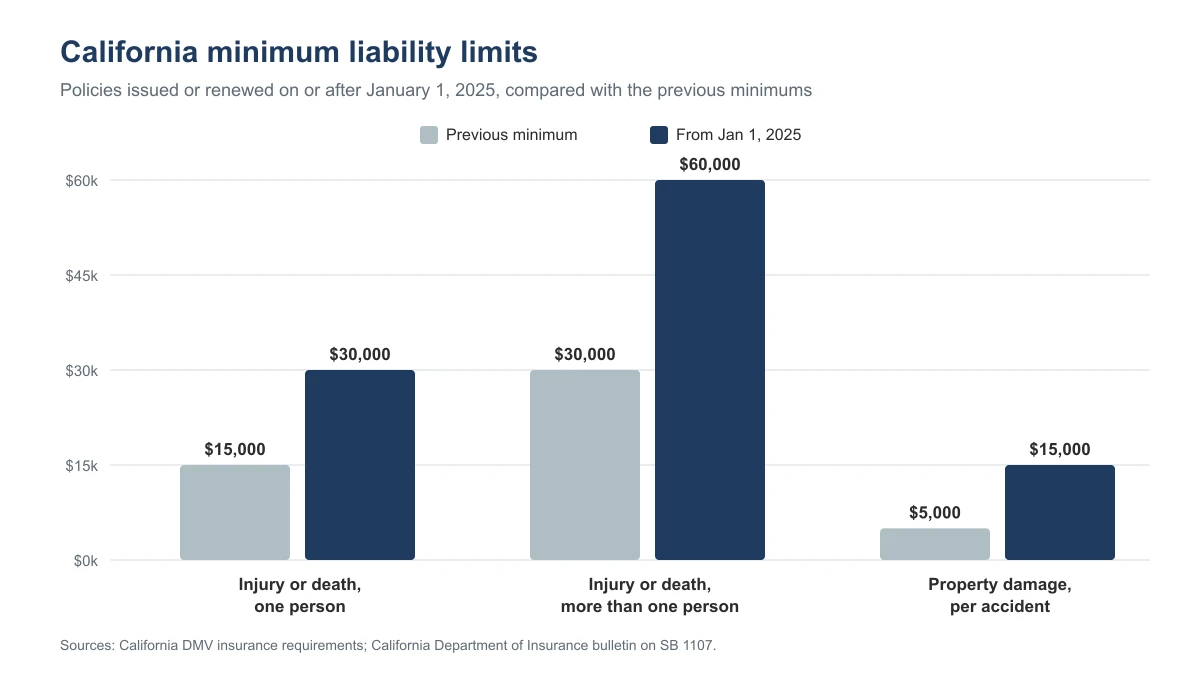
Chart: previous minimums compared with the limits in force from January 1, 2025. Sources: California DMV, CDI bulletin.
The same law schedules another increase for policies issued or renewed on or after January 1, 2035 (SB 1107).
These limits only pay other people when you are at fault, and only up to the limit. A serious injury or a crash with a newer car can exceed them, leaving you personally responsible for the rest. If you own a home, have savings or have a good income, consider limits well above the minimum. Ask an agent to price several levels so you can see what the extra protection costs.
Step 2: Understand the main coverages
The Department of Insurance’s auto insurance guide explains each coverage. In plain terms:
- Bodily injury and property damage liability — pays others when you cause an accident. Required.
- Uninsured / underinsured motorist (UM/UIM) — pays for your and your passengers’ injuries when the at-fault driver has no insurance or too little. The CDI guide notes that uninsured motorist property damage pays up to $3,500 for repairs to your car, which you may not need if you have collision coverage.
- Medical payments — pays medical bills for you and your passengers regardless of fault, up to a set amount.
- Collision — repairs your car after a crash, minus your deductible.
- Comprehensive — covers theft, fire, vandalism, falling objects and similar non-collision damage.
- Extras — rental reimbursement, towing and roadside assistance.
Uninsured motorist coverage: decide deliberately
California insurers must offer UM/UIM coverage, and you can only remove or reduce it by signing a written waiver. That waiver carries over to renewals and replacement policies with the same insurer (Insurance Code §11580.2). Before signing it to save money, consider who pays your medical bills if an uninsured driver hits you.
Collision and comprehensive: match them to your car
If your car is financed or leased, your lender will usually require both. If you own an older car outright, compare the yearly cost of these coverages with what the car is actually worth. A higher deductible lowers the premium but means paying more yourself after a claim — pick a deductible you could pay tomorrow.
Step 3: Know how California prices your policy
California is different from most states. Under Proposition 103, auto premiums must be based on these factors in decreasing order of importance (Insurance Code §1861.02):
- Your driving safety record
- The number of miles you drive each year
- Your years of driving experience
- Other factors approved by the Insurance Commissioner
What this means for you:
- Your record matters most. Tickets and at-fault accidents have the biggest effect on price.
- Report mileage accurately. If you now work from home or drive less, update your estimated annual mileage.
- Claim the Good Driver Discount. If you have been licensed for at least three years, have no more than one violation point and were not principally at fault in an accident causing injury or death, insurers must sell you a Good Driver Discount policy priced at least 20% below what you would otherwise pay (CDI Bulletin 2023-7). The same bulletin says insurers have 15 business days after a completed application to bind coverage for a qualifying good driver.
Step 4: Compare quotes the right way
Prices for the same driver can differ a lot between companies, so shop around — but compare like with like.
- Use identical coverage. Same liability limits, UM/UIM limits, deductibles and extras on every quote. Otherwise the cheapest quote may simply be less coverage.
- Start with the state’s comparison tool. The Department of Insurance surveys insurers every year and publishes sample premiums for typical drivers by ZIP code in its Automobile Insurance Comparison Tool. The figures are examples, not quotes, but they show which companies tend to be cheaper for drivers like you.
- Get at least three real quotes. Mix companies that sell directly with independent agents who can quote several insurers.
- Ask about discounts — bundling with renters or home insurance, multiple vehicles, safety features, good student or defensive driving where offered.
Step 5: Check how the insurer treats customers
A low price is worthless if the company fights every claim. California publishes data that most drivers never look at.
- Consumer Complaint Study. The Department ranks the 50 largest auto insurers by justified complaint ratio — justified complaints per 100,000 exposures — over three years (CDI Consumer Complaint Study). In the 2026 study covering complaint year 2025, ratios ranged from 0.0 to 142.2 (2026 auto composite). Lower is better; look at all three years, not just one.
- Company profile. The Department’s Company Profile Search shows a company’s licence, complaint history and financial information.
- Agent licence. Check any agent or broker with the License Status Inquiry, which also lists enforcement actions.
Step 6: If money is tight, look at the state low-cost program
California’s Low Cost Auto Insurance Program (CLCA) offers liability coverage that meets state requirements for income-eligible good drivers. You must have a valid California driver’s licence, own a vehicle valued at $25,000 or less, be at least 16, have a good driving record or be a new driver, and meet household income limits — for example $39,900 for one person or $82,500 for four people (CLCA qualifications; CLCA FAQ). The program covers liability only, so it is not suitable if your lender requires collision and comprehensive.
Step 7: Read the policy before you pay
- Confirm every driver in your household is listed correctly.
- Check the vehicles, garaging ZIP code and annual mileage.
- Confirm limits, deductibles and any UM/UIM waiver match what you chose.
- Keep proof of insurance in your car or on your phone.
- When switching, start the new policy before cancelling the old one so you are never uninsured.
Quick checklist
- Liability limits above the legal minimum, sized to your assets
- A deliberate decision on UM/UIM — no waiver signed by default
- Collision and comprehensive matched to your car’s value and loan terms
- Good Driver Discount applied if you qualify
- Three or more quotes with identical coverage
- Complaint ratio, company profile and agent licence checked
- Policy details verified before payment
Related guides
- Top Personal Injury Lawyers in New York: How to Choose
- Truck Accident Black Box Data and Liability Claims
- Understanding Life Insurance Policies for Seniors
Sources
- California Department of Insurance, SB 1107 bulletin: new minimum limits
- California DMV, Auto insurance requirements
- California Legislature, SB 1107 bill text
- California Department of Insurance, Automobile insurance guide
- California Insurance Code, §11580.2 and §1861.02
- California Department of Insurance, Bulletin 2023-7: Good Driver Discount policies
- California Department of Insurance, Compare insurance premiums, Consumer Complaint Study, Company Profile Search and License Status Inquiry
- California’s Low Cost Auto Insurance Program, Qualifications and FAQ