Understanding Life Insurance Policies for Seniors
Disclaimer: This article is general information, not insurance, financial, tax or legal advice. arjankc.com.np is not an insurance company, agent or broker and does not sell policies or receive commissions. Rules differ by state; confirm details with a licensed agent, your state insurance department or a financial adviser.
Last reviewed: 13 October 2026
Life insurance decisions look different after 60. The reasons for buying change — covering a funeral, paying off a mortgage, leaving money to family, or providing for a spouse — and so do prices and choices. This guide explains the main policy types, the fine print that matters most for older buyers, and how to protect yourself from common mistakes.
First, decide what the money is for
Before comparing policies, write down what you want the insurance to do and for how long:

- Final expenses — funeral, burial or cremation and small debts.
- A specific debt — such as the remaining years on a mortgage.
- Income for a spouse — replacing a pension or Social Security benefit that would shrink or stop.
- A legacy — leaving money to children, grandchildren or a charity.
- Estate planning — for larger estates, coordinated with a lawyer or tax adviser.
A short, specific need usually points to term insurance. A lifelong need usually points to permanent insurance.
The main types of life insurance
The National Association of Insurance Commissioners (NAIC) explains the differences in its Life Insurance Buyer’s Guide and life insurance overview.
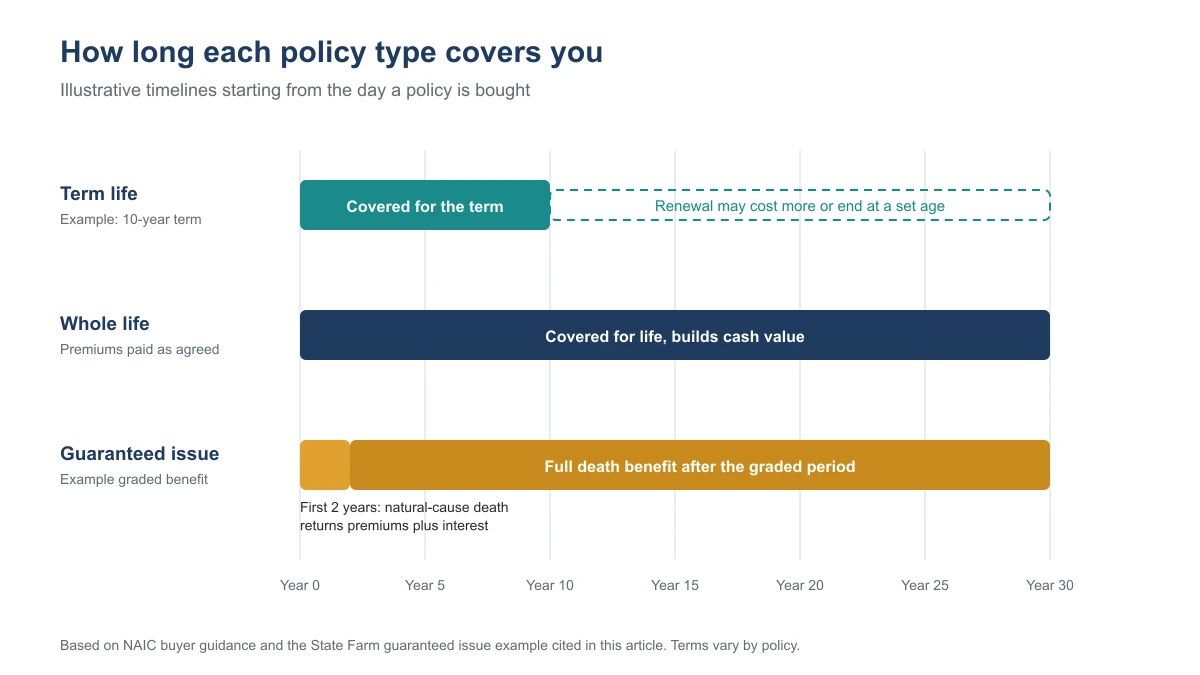
Diagram: illustrative timelines only. Terms, renewal rules and graded periods vary by policy and insurer.
Term life insurance
Term insurance covers you for a set period — for example 10 or 20 years, or to a specified age — and pays only if you die during that term. It is usually the cheapest way to buy a large amount of coverage for a temporary need. Most term policies build no cash value. Many can be renewed at the end of the term, but at higher premiums, and some stop being renewable at a certain age. Ask what renewal would cost before you buy.
Whole life insurance
Whole life covers you for life as long as premiums are paid. Premiums are generally level and higher than term at first, and the policy builds cash value that grows tax-deferred and can be borrowed against. State law requires nonforfeiture values, so if you stop paying, you can take the cash value or a reduced amount of insurance instead of losing everything (NAIC).
Universal life insurance
Universal life is permanent coverage with flexible premiums. Your payments, minus charges, go into an account that earns interest. The NAIC warns that if payments plus interest are less than the charges, the account falls and coverage can end unless you pay more or reduce the death benefit (NAIC buyer’s guide). This matters for seniors because the cost of insurance inside the policy rises with age. Ask for an illustration showing what happens if interest rates are lower than projected.
Variable life insurance
Variable life links the cash value to investment options, usually mutual funds. The SEC notes it is regulated as a security, comes with a prospectus, and that substantial fees and tax implications generally make it unsuitable as a short-term savings vehicle (Investor.gov). It carries the greatest potential for growth and the greatest risk of losing cash value.
Final expense and guaranteed issue policies
Final expense (or burial) insurance is usually a small whole life policy meant to cover funeral costs and small bills. There are two common kinds:
- Simplified issue — no medical exam, but you answer health questions. If you are accepted, full coverage usually starts right away.
- Guaranteed issue — no health questions within the eligible age range. In exchange, these policies usually cost more per dollar of coverage and often carry a graded death benefit.
With a graded benefit, a natural-cause death in the first policy years pays back the premiums plus interest rather than the full face amount. For example, State Farm’s guaranteed issue final expense policy states that death from natural causes in the first two policy years pays the return of premium plus interest (State Farm). Before buying, ask in writing:
- What exactly is paid for a natural-cause death in month one, year one and year two?
- Is accidental death paid in full from day one?
- Are premiums guaranteed never to increase?
If you are reasonably healthy, a simplified issue policy may offer full coverage sooner and for less.
If the goal is paying for a funeral, compare insurance with planning directly with a funeral home. Under the FTC’s Funeral Rule, funeral providers must give you an itemized General Price List, including for pre-need arrangements (FTC).
Group and employer coverage
Coverage through a former employer or association may end or become much more expensive at retirement. Check whether it can be converted to an individual policy, what that would cost, and how long you have to decide.
The fine print that matters most
- Free-look period. Most states let you cancel a new policy within a set number of days after delivery — often at least 10 — for a refund. The length differs by state and policy type (NAIC model law chart).
- Contestability. Answer health questions honestly. Misstatements can lead to a denied claim.
- Premium guarantees. Know whether premiums are guaranteed for life, for a period, or can change.
- Beneficiaries. Name primary and contingent beneficiaries and update them after a death, divorce or remarriage.
- Replacing a policy. Be cautious if someone suggests swapping an older policy for a new one. A new policy may restart waiting periods and cost more at your current age.
Taxes
Life insurance proceeds paid because of the insured person’s death are generally not taxable income to the beneficiary, but interest paid on those proceeds is taxable (IRS). For variable life, the SEC notes that withdrawals of gains are taxed at ordinary income rates, and a policy that ends with a loan outstanding can create a tax bill (Investor.gov). Larger estates should get tax advice.
Selling a policy: life settlements
A life settlement is the sale of your policy to a third party for cash that is less than the death benefit (NAIC). It can help if you no longer need or can afford the policy, but FINRA warns of unexpected tax liabilities, reduced access to coverage, release of private medical information and high transaction costs, and advises checking that the buyer and broker are licensed in your state (FINRA). Before selling, ask the insurer about alternatives such as reducing coverage or using the policy’s cash value.
Finding a lost policy
If a family member has died and you believe they had a policy, the NAIC’s free Life Insurance Policy Locator helps beneficiaries find lost policies and unclaimed death benefits.
How to shop
- Decide the amount and how long you need coverage.
- Get quotes from several insurers for the same coverage amount and type.
- Check that the agent and insurer are licensed with your state insurance department.
- Read the policy, including any graded benefit and premium guarantees, during the free-look period.
- Tell your beneficiaries where the policy is kept.
Related guides
- How to Choose the Best Auto Insurance in California
- Best Mortgage Refinance Rates in 2026: How to Find Yours
- Offshore Asset Protection: A Compliance-First Guide
- Fixed Annuities vs High-Yield Savings: Capital Preservation
Sources
- NAIC, Life Insurance Buyer’s Guide, Universal life buyer’s guide, Life insurance overview, Consumer life insurance resources and policy locator and Life insurance disclosure model law chart
- SEC Investor.gov, Variable life insurance and Investor Bulletin: Variable Life Insurance
- FINRA, What You Should Know About Life Settlements
- IRS, Life insurance and disability insurance proceeds
- FTC, Complying with the Funeral Rule
- State Farm, Guaranteed Issue Final Expense insurance (example of graded benefit terms)