Best Mortgage Refinance Rates in 2026: How to Find Yours
Disclaimer: This article is general education, not financial, tax or legal advice. arjankc.com.np is not a lender or broker, does not recommend any lender and earns no referral fees. Rates change daily; figures below were current on the date reviewed. Speak with a licensed loan officer or a HUD-approved housing counselor about your situation.
Last reviewed: 13 October 2026
There is no single “best” refinance rate that applies to everyone. The rate you are offered depends on your credit, how much equity you have, the loan type and term, the points you pay and the lender. What you can do is find out where the market stands, work out whether refinancing makes sense for you, and shop properly so you get the best rate available to you.
Where mortgage rates stand in October 2026
Freddie Mac’s Primary Mortgage Market Survey, published every Thursday, is the most widely quoted benchmark. As of October 8, 2026 (Freddie Mac PMMS):
Finance Calculator
Use this calculator to estimate repayments or growth before you compare providers.
| Loan type | Weekly average | A week earlier | A year earlier |
|---|---|---|---|
| 30-year fixed rate | 7.40% | 7.28% | 6.30% |
| 15-year fixed rate | 6.73% | 6.60% | 5.53% |
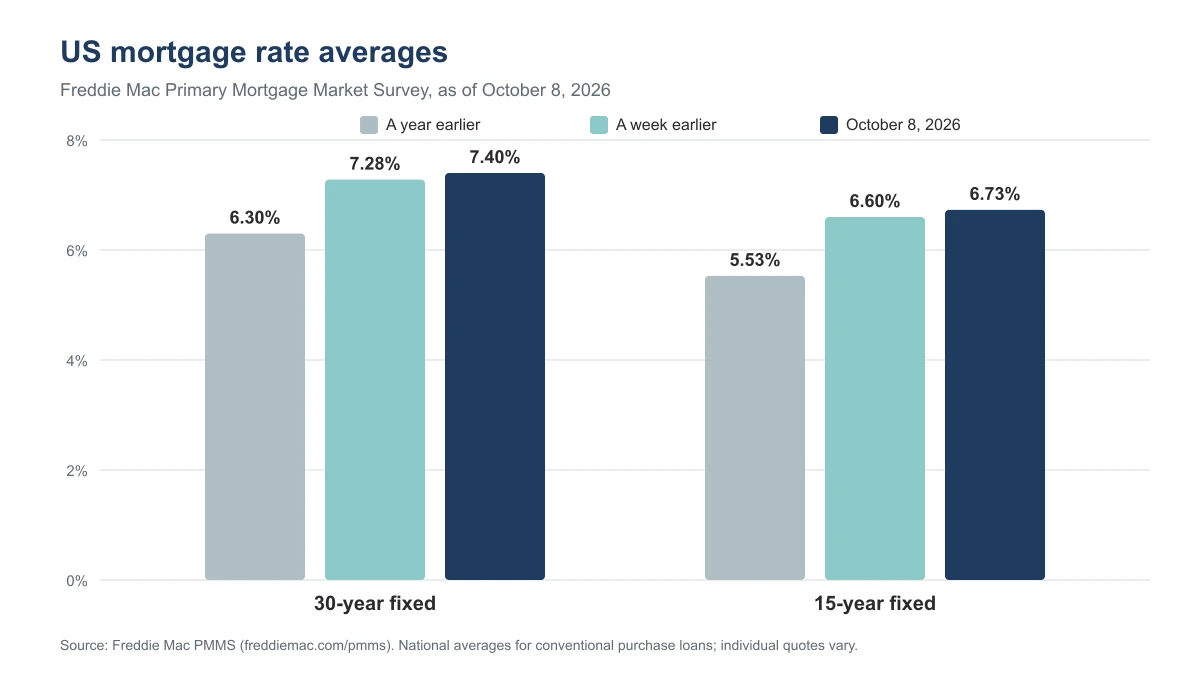
Chart: Freddie Mac PMMS averages as of October 8, 2026. Data: Freddie Mac.
Two things to keep in mind about these numbers:
- They are averages, not offers. The survey is based on loan applications submitted to Freddie Mac for conventional, conforming home purchase loans, with a borrower profile of good to excellent credit and a 20% down payment. A refinance quote for your loan can differ.
- Rates have risen over the past year. If you took out or refinanced your mortgage when rates were lower, a new loan at today’s rates is unlikely to cut your payment. Refinancing today makes most sense for homeowners whose current rate is meaningfully above the market, or who have a specific goal such as removing a co-borrower or switching from an adjustable to a fixed rate.
Rate versus APR: compare both
The CFPB explains that the interest rate is the yearly cost of borrowing, while the APR also reflects points, broker fees and other charges, which is why the APR is usually higher. On a Loan Estimate, the interest rate is on page 1 under “Loan Terms” and the APR is on page 3 under “Comparisons.” The CFPB warns against looking at APR alone, and especially against comparing APRs of fixed and adjustable-rate loans (CFPB).
What refinancing costs
Refinancing means paying closing costs again. Freddie Mac says to expect 3% to 6% of your loan principal, depending on your lender, credit score and location. Costs typically include origination, appraisal, credit report, title, recording, survey, attorney and underwriting fees (Freddie Mac).
Be careful with “no-cost” offers. Freddie Mac notes there is no such thing as a free loan: the lender is probably charging a higher rate or rolling costs into the loan, which may cost more over its life.
Points and lender credits
- Points (discount points) lower your rate in exchange for paying more at closing. One point equals 1% of the loan amount.
- Lender credits work in reverse: you accept a higher rate and the lender covers some closing costs.
The CFPB says points can make sense if you plan to keep the loan a long time. If you are unsure, ask for quotes with and without points and compare total costs over your shortest, longest and most likely time in the loan. When comparing lenders, ask each for the same number of points or credits (CFPB). Freddie Mac adds that its research found no significant financial benefit to buying points (Freddie Mac).
Does refinancing pay off? Work out your break-even point
Divide your total closing costs by your monthly savings to see how many months it takes to recover them.
Illustrative example (not a quote): you owe $300,000 at 8.25% and refinance into a new 30-year loan at 7.40%, the October 8 average. Principal and interest falls from about $2,254 to about $2,077 a month, a saving of about $177.
| Closing costs | Amount | Months to break even |
|---|---|---|
| 3% of loan | $9,000 | about 51 (4¼ years) |
| 6% of loan | $18,000 | about 102 (8½ years) |
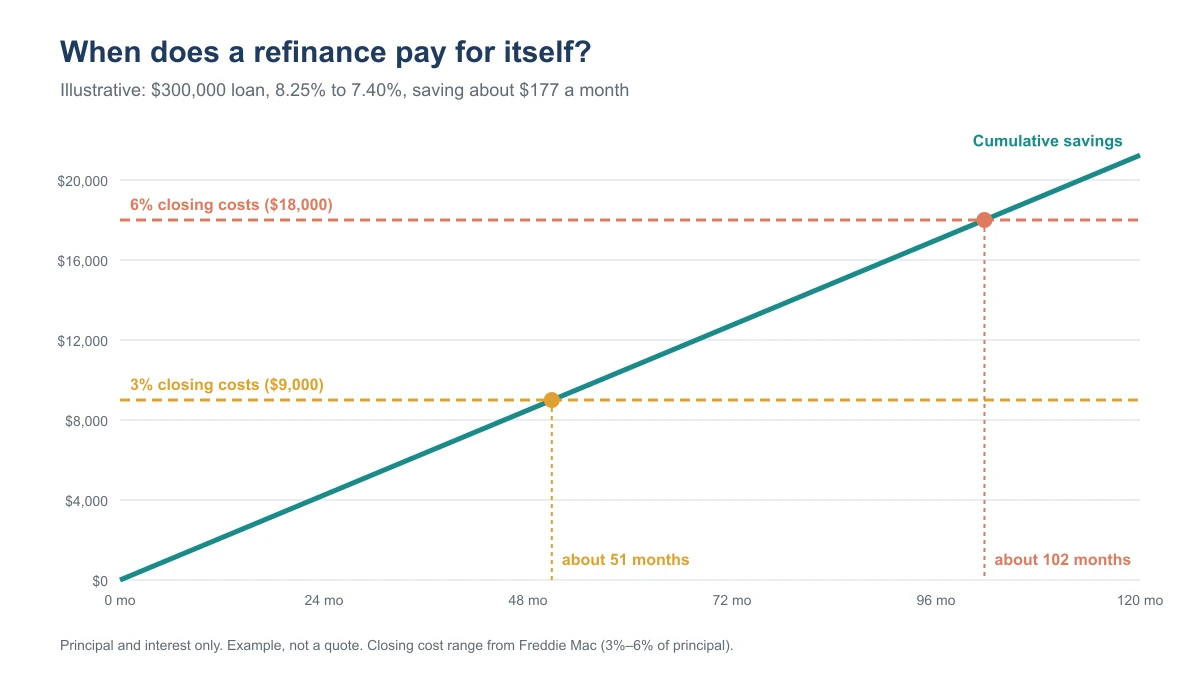
Chart: the illustrative example above. Principal and interest only; not a quote.
If you might sell or refinance again before the break-even point, refinancing may cost more than it saves. Also note that restarting a 30-year term can increase the total interest you pay even if the monthly payment falls.
How to shop for the best refinance rate
- Check your credit first. Your credit score affects both your rate and your closing costs (Freddie Mac).
- Get several quotes. Freddie Mac recommends interviewing several lenders, including your current one, and notes that getting multiple quotes can save thousands over the life of a loan (Freddie Mac PMMS).
- Compare official Loan Estimates. Every lender must use the same three-page Loan Estimate form and send it within three business days of your application, which makes side-by-side comparison easier. Check for prepayment penalties or negative amortization (CFPB).
- Compare like with like. Same loan type, same term, same points or credits.
- Lock your rate at the right time. A rate lock holds your rate until closing, as long as you close within the lock period (typically 30, 45 or 60 days) and nothing in your application changes. Ask what an extension costs and what happens if rates fall after you lock (CFPB).
Watch out for mortgage scams
The FTC warns that it is illegal for a company to charge an upfront fee for promises to get you mortgage relief. Red flags include demands for payment by wire transfer, cashier’s check or payment app, instructions to stop talking to your lender, and requests to sign over the deed to your home. Report suspected scams at ReportFraud.ftc.gov and to your state attorney general (FTC).
The bottom line
The “best” refinance rate is the lowest total cost you can get for the loan you actually need. Use the weekly averages as a benchmark, gather several Loan Estimates, compare rates, APRs and closing costs on the same terms, and refinance only if you will stay in the loan past the break-even point.
Related guides
- Commercial Real Estate Bridge Loans vs Permanent Debt
- A Beginner’s Guide to Investing in Cryptocurrencies
- Understanding Life Insurance Policies for Seniors
- Fixed Annuities vs High-Yield Savings: Capital Preservation
Sources
- Freddie Mac, Primary Mortgage Market Survey and Understanding the costs of refinancing
- Consumer Financial Protection Bureau, Interest rate vs APR, Points and lender credits, What is a Loan Estimate? and Rate locks
- Federal Trade Commission, Mortgage relief scams