Fixed Annuities vs High-Yield Savings: Capital Preservation
Disclaimer: This article is general information, not financial, tax or legal advice. arjankc.com.np is not a bank, insurer, broker or adviser, does not recommend or rank specific products or providers, and does not receive referral fees or commissions. Rates, limits and rules change; check current terms with the institution, your state insurance department and a licensed professional before acting.
Last reviewed: 13 October 2026
If your main goal is to keep money safe rather than chase growth, two products usually come up: high-yield savings accounts at banks or credit unions, and fixed annuities from insurance companies, especially multi-year guaranteed annuities (MYGAs). Both are marketed for capital preservation. Both pay a stated rate. Under the surface they work very differently: who guarantees the money, how quickly you can reach it, how the interest is taxed, and what happens if the institution fails.
This guide compares the two side by side using official sources: the FDIC and NCUA on deposit insurance, NOLHGA on annuity guaranty coverage, the IRS on taxation, and the SEC, FINRA and NAIC on how annuities are sold. It ends with a decision framework and an explanation of laddering. It does not quote annuity rates, because there is no official national source for them, and it does not recommend any product or company.
Finance Calculator
Use this calculator to estimate repayments or growth before you compare providers.
What each product is
High-yield savings and money market deposit accounts
A savings account is a deposit. You lend money to a bank or credit union, which pays interest at a rate it can change at any time. “High-yield” is a marketing label, not a regulatory category: it simply means the rate is above the national average. Money market deposit accounts are similar, sometimes with check-writing. Certificates of deposit (CDs) lock in a rate for a term in exchange for an early withdrawal penalty set by the bank.
Deposits at FDIC-insured banks are protected up to $250,000 per depositor, per FDIC-insured bank, per ownership category, such as single accounts, joint accounts and certain retirement accounts (FDIC, Understanding Deposit Insurance). Credit union shares have parallel coverage through the National Credit Union Share Insurance Fund: $250,000 per share owner, per insured credit union, per account ownership category (NCUA, Share Insurance Coverage). Both are backed by the full faith and credit of the United States.
Fixed annuities and MYGAs
A fixed annuity is a contract with an insurance company. During the accumulation phase, the insurer credits interest at a rate it guarantees, and you can later take withdrawals or convert the balance into a stream of income. The SEC’s Investor.gov explains that fixed annuities guarantee at least a minimum interest rate during accumulation, that the insurance company sets the rates, and that fixed annuities are insurance products regulated by state insurance regulators rather than the SEC (Investor.gov, Annuities).
FINRA adds that with a fixed annuity, the insurer guarantees both the rate of return and the payout, and that the rate is often fixed for a number of years and then changes periodically (FINRA, Annuities). A multi-year guaranteed annuity (MYGA) is the common form of this: a single premium earns a declared rate for a set guarantee period, such as three, five or seven years. MYGAs are often compared with CDs because the structure looks similar, but the legal protections and costs differ.
Fixed annuities are different from fixed indexed annuities, whose credited interest is tied to a market index with caps and participation rates, and from variable annuities and registered index-linked annuities (RILAs), which are securities registered with the SEC. This guide covers only traditional fixed annuities and MYGAs.
Current deposit rates from an official source
There is no government benchmark for annuity rates, and insurer quotes change often. For deposits, the FDIC publishes national average rates and national rate caps each month. The chart below uses the FDIC release for 21 September 2026.
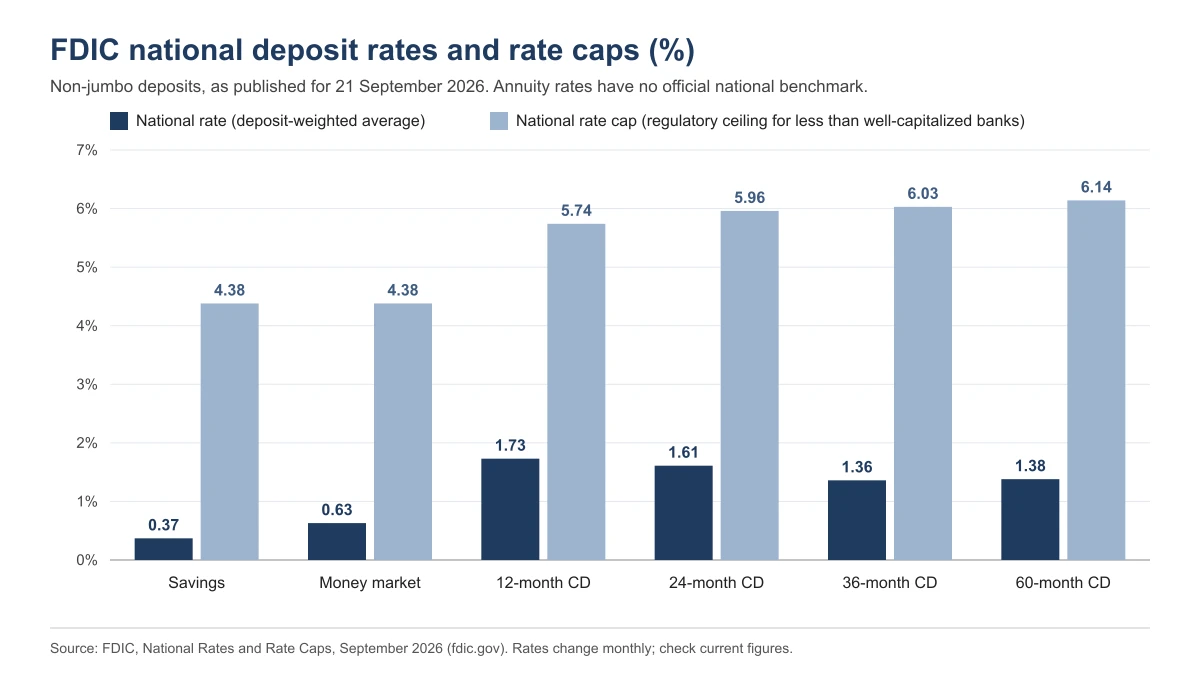
Chart: arjankc.com.np, from FDIC National Rates and Rate Caps, 21 September 2026.
| Product | FDIC national rate (%) | FDIC national rate cap (%) |
|---|---|---|
| Savings | 0.37 | 4.38 |
| Money market | 0.63 | 4.38 |
| 12-month CD | 1.73 | 5.74 |
| 24-month CD | 1.61 | 5.96 |
| 36-month CD | 1.36 | 6.03 |
| 60-month CD | 1.38 | 6.14 |
Source: FDIC, National Rates and Rate Caps, September 2026.
Two points help in reading these numbers. First, the national rate is a deposit-weighted average across all banks, so it includes large banks that pay very little; online “high-yield” accounts typically advertise rates well above it. Second, the rate cap is not a market rate. It is a regulatory ceiling that limits what banks that are less than well capitalized may pay, set at the higher of the national rate plus 75 basis points or 120% of the comparable Treasury yield plus 75 basis points. When you shop, compare the actual annual percentage yield (APY) offered, the date it was quoted, and whether it is a promotional rate.
For annuities, ask for the guaranteed rate, the guarantee period, the minimum guaranteed rate after that period ends, and the full surrender charge schedule, in writing.
Side-by-side comparison
| Feature | High-yield savings / money market (insured) | Fixed annuity / MYGA |
|---|---|---|
| Who backs it | Bank or credit union, plus FDIC or NCUA insurance | Issuing insurance company, plus state guaranty association up to limits |
| Protection limit | $250,000 per depositor, per institution, per ownership category | Varies by state; most states at least $250,000 in present value of annuity benefits |
| Federal guarantee | Yes, full faith and credit of the US | No; FDIC states annuities are not FDIC-insured |
| Rate | Variable; bank can change it at any time | Guaranteed for the stated period, then resets |
| Access to money | Generally immediate | Limited; surrender charges and possibly a market value adjustment for early withdrawals |
| Tax on interest | Taxable each year as ordinary income | Tax-deferred until withdrawn; then taxed as ordinary income |
| Early withdrawal tax | None | 10% additional tax on taxable portion before 59½, with exceptions |
| Who regulates | FDIC, NCUA, OCC, Federal Reserve, state banking regulators | State insurance departments |
| Typical use | Emergency fund, short-term goals, cash reserves | Money set aside for a defined multi-year period, often for retirement |
Sources: FDIC, NCUA, NOLHGA, IRS and FINRA, linked throughout this article.
Surrender charges and market value adjustments
The main trade-off with a fixed annuity is liquidity. FINRA describes the surrender period as the time during which you will pay a surrender charge if you withdraw more than the free amount, and notes that exchanging one annuity for another can start a new surrender period (FINRA, Annuities). Surrender charges usually decline year by year, but the schedule is set by each contract.
Many fixed contracts also include a market value adjustment (MVA). The NAIC annuity buyer’s guide, as adopted in state regulations, explains that if interest rates are higher when you withdraw than when you bought the contract, the MVA generally reduces the amount you receive; if rates are lower, it may increase it (NAIC buyer’s guide, Ohio Admin. Code 3901-6-14 appendix). The same guide notes that many contracts allow you to take a portion of the value, often around 10% a year, without a surrender charge. Check your own contract, because free-withdrawal provisions vary.
Before buying, confirm:
- the length of the surrender period and the charge in each year;
- whether an MVA applies and how it is calculated;
- the annual free-withdrawal amount and whether it carries over;
- waivers for nursing home confinement, terminal illness or death;
- the free-look period, which FINRA says generally lasts 10 to 30 days depending on the state, during which you can cancel.
A savings account has none of these features. A CD has an early withdrawal penalty, but it is usually a set number of days’ or months’ interest, disclosed up front by the bank.
Taxes: deferral and the 10% additional tax
Interest on a savings account or CD is taxable as ordinary income in the year it is credited, even if you leave it in the account (IRS Topic 403, Interest Received).
A non-qualified deferred annuity, meaning one bought with after-tax money outside a retirement plan, grows tax-deferred. You pay tax only when you take money out, and earnings come out first for most withdrawals before the annuity starting date. FINRA notes that gains are taxed as ordinary income rather than at capital gains rates (FINRA, Annuities).
Under 26 U.S.C. section 72(q), the taxable portion of an annuity distribution taken before age 59½ is generally subject to a 10% additional tax. Exceptions include distributions after the owner’s death, distributions due to disability and a series of substantially equal periodic payments, among others. IRS Publication 575 explains how annuity income is taxed. This tax is separate from any surrender charge, so an early withdrawal can trigger both.
Tax deferral is worth more to people who expect to be in a lower bracket when they withdraw and who will not need the money before 59½. If the money is already inside a tax-deferred account such as an IRA, an annuity does not add a second layer of deferral, so ask what other benefit justifies its costs and restrictions.
How safe is each one?
Deposit insurance
Insured deposits within the limits are protected by the federal government. If you hold more than $250,000, you can spread money across ownership categories or across separately chartered banks; the FDIC’s Electronic Deposit Insurance Estimator can help you check coverage. The FDIC is explicit that annuities, mutual funds, stocks, bonds and life insurance policies are not FDIC-insured, even when sold at a bank (FDIC, Financial Products That Are Not Insured).
State guaranty associations
Annuities rely first on the financial strength of the insurer. If an insurer becomes insolvent, state life and health insurance guaranty associations step in, coordinated nationally by NOLHGA. According to NOLHGA:
- every state covers at least $250,000 in present value of annuity benefits, and most set the limit at $250,000;
- some states set higher limits, for example $300,000 in North Carolina, and New Jersey covers $500,000 for annuities in payout status;
- California covers 80% of the contract value, up to $250,000;
- coverage generally applies per person, per insolvent company, and amounts above the limit become a claim against the insurer’s estate.
(NOLHGA, Product Coverage FAQs; NOLHGA, How You’re Protected)
NOLHGA gives an example in which an annuity worth $300,000 in a state with a $250,000 limit would be covered for about 83.3% of its value. Coverage depends on your state of residence, so check your state’s guaranty association. Also note that under the NAIC guaranty association model act, agents are generally prohibited from using guaranty coverage as a sales tool (Federal Reserve Bank of Chicago, Economic Perspectives 2024-3). If a salesperson leans on it, treat that as a warning sign.
Insurer financial strength ratings
Because the guaranty system is a backstop, not a first line of defense, regulators suggest checking the insurer itself. FINRA recommends reviewing insurer financial strength ratings from independent rating agencies such as S&P before buying (FINRA, Annuities). Ratings agencies use different scales, so compare like with like, and look at the rating history rather than a single snapshot. You can also look up the insurer’s license and complaint history through your state insurance department or the NAIC Consumer Insurance Search.
Rules for the people selling annuities
NAIC best interest model (#275)
Most fixed annuities are sold by insurance-licensed agents under state law. In 2020 the NAIC revised its Suitability in Annuity Transactions Model Regulation (#275) to add a best interest standard. It requires producers to meet care, disclosure, conflict of interest and documentation obligations, and not to put their own financial interest ahead of the consumer’s (NAIC Model #275). According to the NAIC, as of August 2025 the revised model had been adopted in 49 jurisdictions; New York has its own rule, Regulation 187, which also applies a best interest standard (NAIC government affairs brief).
In practice, the producer must gather information about your financial situation, liquidity needs, time horizon and tax status, and must disclose how they are paid. You can ask for the disclosure form and the basis for the recommendation.
SEC Regulation Best Interest
The SEC’s Regulation Best Interest (Reg BI), adopted on 5 June 2019, applies when a broker-dealer recommends a security to a retail customer (SEC, Reg BI compliance guide). That covers variable annuities and RILAs, but traditional fixed annuities are not securities, so the state insurance rules above apply instead. If the same person sells you both kinds of product, different rules may govern each sale.
Regulator investor alerts
FINRA’s investor guidance lists points to check before buying any annuity: understand the surrender period, ask about fees and commissions, check the insurer’s ratings, use the free-look period, and be cautious about exchanging an existing annuity, since that can restart surrender charges. FINRA also notes that fixed annuity payouts typically have no cost-of-living adjustment, so inflation can erode their purchasing power, and that locking in a rate means you may miss out if rates rise later (FINRA, Annuities).
A decision framework
Rather than asking which product is “better”, work through these questions:
- When might you need the money? If there is a realistic chance you will need it within the surrender period, or before 59½, insured deposits are usually the more flexible tool. Annuities are long-term products by design.
- Is it your emergency fund? Emergency savings need to be available immediately and at full value. That points to an insured savings or money market account.
- Do you want the rate fixed? A savings rate can fall at any time. A CD or MYGA locks a rate for a term; compare the after-tax yield, the penalty for leaving early and the guarantee behind each.
- How much are you protecting? Map balances to FDIC or NCUA ownership categories and to your state’s guaranty limit. Spread large sums so each piece stays within coverage.
- What is your tax position? Deferral may help if you are in a high bracket now and expect a lower one later, and if the money is outside a tax-advantaged account.
- How strong is the insurer? Check ratings and the state license; do not rely on guaranty coverage alone.
- What does the seller earn? Ask about commissions and how they affect the rate, and get the recommendation’s reasoning in writing.
| If your priority is… | Features to look for |
|---|---|
| Instant access and federal insurance | Insured savings or money market account within FDIC or NCUA limits |
| A locked rate for one to five years | CDs or MYGAs; compare penalties, guarantees and taxation |
| Tax deferral on money not needed before 59½ | Fixed annuity; review surrender schedule, MVA and insurer ratings |
| Future lifetime income | Annuitization options, which are beyond capital preservation and need separate advice |
Laddering for flexibility
A ladder splits money across several maturities instead of locking it all into one term. With CDs, you might buy one-, two-, three-, four- and five-year certificates; as each matures, you either spend the money or reinvest it at the long end. The same idea can be applied to MYGAs with different guarantee periods, or to a mix of CDs and annuities.
Laddering can:
- give you regular points at which money becomes available without penalty;
- reduce the risk of locking everything in just before rates rise;
- help keep each contract or account within insurance or guaranty limits if you use several institutions.
The costs are more paperwork and the chance that some rungs earn less than a single long-term contract would have. With annuities, each rung has its own surrender schedule and possibly an MVA, so track the dates carefully. Remember that annuity withdrawals before 59½ may still face the 10% additional tax even when no surrender charge applies.
Common mistakes to avoid
- Assuming an annuity bought at a bank branch is FDIC-insured. It is not.
- Comparing an advertised annuity rate with the FDIC national average rather than with the best insured rates you can actually get.
- Ignoring that a savings rate can drop the day after you open the account.
- Putting emergency money in a product with a multi-year surrender period.
- Exchanging an existing annuity without checking whether it restarts surrender charges.
- Holding more than the guaranty limit with one insurer, or more than $250,000 in one ownership category at one bank, without realizing it.
Related guides
- Understanding Life Insurance Policies for Seniors
- Best Mortgage Refinance Rates in 2026: How to Find Yours
- Offshore Asset Protection: A Compliance-First Guide
Sources
- FDIC: National Rates and Rate Caps, September 2026
- FDIC: Understanding Deposit Insurance
- FDIC: Financial Products That Are Not Insured by the FDIC
- FDIC: Electronic Deposit Insurance Estimator (EDIE)
- NCUA: Share Insurance Coverage
- NOLHGA: Product Coverage FAQs and How You’re Protected
- Federal Reserve Bank of Chicago: Economic Perspectives 2024-3
- US Code: 26 U.S.C. section 72
- IRS: Publication 575, Pension and Annuity Income and Topic 403, Interest Received
- SEC Investor.gov: Annuities
- SEC: Regulation Best Interest small entity compliance guide
- FINRA: Annuities
- NAIC: Suitability in Annuity Transactions Model Regulation (#275) and government affairs brief
- NAIC annuity buyer’s guide as adopted in Ohio Admin. Code 3901-6-14