Robotic Surgery and AI Diagnostics Malpractice Liability
Disclaimer: This article is general information, not legal or medical advice. arjankc.com.np is not a law firm, healthcare provider or insurer, does not recommend or rank specific attorneys, and does not receive referral fees. Medical malpractice and product liability law varies by state and changes over time; speak to a licensed attorney in your state about your situation.
Last reviewed: 13 October 2026
Robotic-assisted surgery and AI-enabled diagnostic software are now part of routine care in many US hospitals. When a patient is harmed, the question of who is responsible becomes more complicated than in a traditional surgery. The surgeon controls the robot, the hospital buys it and decides who may use it, the manufacturer designs it and trains users, and software may influence the diagnosis before the operation begins. This guide explains how medical malpractice and product liability apply to robotic surgery and AI diagnostics, how the FDA regulates these devices, why federal preemption matters, what evidence is involved, and how filing deadlines and damage rules differ by state. It is a starting point for questions to ask a robotic surgery malpractice attorney, not a substitute for one.
How the FDA regulates surgical robots and AI software
Robotically assisted surgical devices
The FDA calls these systems robotically assisted surgical (RAS) devices. It has cleared RAS devices for use by trained physicians in an operating room for laparoscopic procedures in general, cardiac, colorectal, gynecologic, head and neck, thoracic and urologic surgery. The FDA notes that these clearances for procedures commonly performed in cancer patients, such as hysterectomy, prostatectomy and colectomy, are based on short-term (30-day) patient follow-up, and that safety and effectiveness for cancer outcomes such as overall survival and recurrence have not been established (FDA, Computer-Assisted Surgical Systems).
The FDA also says it does not supervise or accredit physician training. Training is the responsibility of the manufacturer, physicians and health care facilities. In September 2026 the FDA issued a draft guidance on premarket submissions for RAS devices, which recommends that each manufacturer develop a validated training program covering surgeons and other operating room staff (FDA draft guidance, September 2026). Draft guidance is not binding, but it shows what the agency expects.
510(k) clearance versus premarket approval
The pathway a device used to reach the market matters later, in court:
| Pathway | What it means | Where it is set out |
|---|---|---|
| 510(k) premarket notification | Device shown to be “substantially equivalent” to a legally marketed predicate device | 21 CFR Part 807, Subpart E |
| De Novo classification | Risk-based classification of a novel low-to-moderate risk device with no predicate | FD&C Act section 513(f)(2) |
| Premarket approval (PMA) | Device-specific review of safety and effectiveness, generally for class III devices | 21 CFR Part 814 |
Many RAS systems have reached the market through 510(k) clearance. For example, the maker of the da Vinci system states that the FDA cleared its surgical systems through the 510(k) process for many indications (Intuitive statement), and the FDA has also used De Novo to create new RAS device types, such as the 2021 order classifying a transvaginal robotic system and substantially equivalent devices of that type into class II (FDA De Novo DEN190022). Always check the specific device, instrument and indication in the FDA’s databases rather than assuming.
AI-enabled diagnostic and decision support software
Software can itself be a medical device. The FDA’s Clinical Decision Support Software guidance (issued 29 January 2026, superseding a version from earlier that month) explains which software functions are excluded from the device definition under section 520(o)(1)(E) of the FD&C Act. To be “non-device” CDS, a function must meet all four statutory criteria, including that it is intended for health care professionals and lets them independently review the basis for its recommendations. Functions that analyze medical images or signals, or that do not let the clinician independently review the basis, remain devices (FDA, Clinical Decision Support Software).
For AI-enabled devices, the FDA has a draft guidance, Artificial Intelligence-Enabled Device Software Functions: Lifecycle Management and Marketing Submission Recommendations, describing what manufacturers should document about model design, data, performance and monitoring across the product life cycle (FDA draft guidance PDF). The FDA also maintains a public list of AI-enabled devices it has authorized.
This regulatory status affects liability arguments: whether software was a cleared device, whether it was used within its labeled indications, and whether the clinician was expected to review its output independently.
Medical malpractice: the four elements
A medical malpractice claim against a surgeon, radiologist or hospital is a negligence claim. Although wording varies by state, a plaintiff generally must prove:
- Duty: a provider-patient relationship existed.
- Breach: the provider failed to meet the standard of care, meaning what a reasonably careful provider in the same specialty would have done in similar circumstances.
- Causation: the breach caused the injury, as opposed to the underlying disease or a known risk that occurred without negligence.
- Damages: the patient suffered losses such as medical costs, lost income, pain and suffering or, in a death case, losses to the family.
In robotic surgery cases, the standard-of-care questions often include whether robotic surgery was appropriate for this patient, whether the surgeon had adequate training and experience on the specific system, whether complications such as burns or punctures from instruments were recognised and treated in time, and whether the surgeon should have converted to an open or conventional laparoscopic procedure. With AI diagnostics, the question is usually whether a reasonably careful clinician would have accepted, questioned or overridden the software’s output.
Expert testimony is almost always needed to establish the standard of care and causation, and many states require expert support before or shortly after a lawsuit is filed (see the state comparison below).
Informed consent for robotic procedures
Patients have a right to the information a reasonable person would want before agreeing to treatment. California’s Supreme Court, for example, held in Cobbs v. Grant (1972) that physicians must disclose the information material to a patient’s decision, including significant risks and available alternatives (Cobbs v. Grant, Justia). States use different tests, some based on what a reasonable patient would want and others on what a reasonable physician would disclose.
Informed consent questions specific to robotic surgery include:
- whether the patient was told the procedure would be robot-assisted and what alternatives existed;
- whether the patient was told about the surgeon’s own experience with the system, where state law requires or courts consider it;
- whether the use was within the device’s cleared indications (in 2019 the FDA warned that RAS devices had not been granted marketing authorization for mastectomy or for preventing or treating cancer, and that their benefits for cancer outcomes had not been established);
- whether the possibility of converting to an open procedure was explained.
A signed consent form is evidence, but it does not automatically defeat a claim if the discussion behind it was inadequate.
Product liability versus malpractice: who may be responsible
The surgeon
Claims against the surgeon are malpractice claims and turn on the standard of care. A device problem does not excuse a surgeon who failed to notice or respond to it appropriately, and a surgeon’s error is not a device defect.
The hospital
A hospital may be liable for its own negligence, including:
- Negligent credentialing: granting or renewing privileges to perform robotic procedures without reasonable review of competence. In Elam v. College Park Hospital (1982), a California appellate court held that a hospital owes patients a duty to use reasonable care in selecting and periodically reviewing the competence of its medical staff, even for independent physicians who are not its employees (Elam, Justia).
- Inadequate staff training, system set-up, maintenance or instrument processing.
- Vicarious liability for employees, and in some states for physicians who appear to act as the hospital’s agents.
Hospital peer review and credentialing records are often protected from discovery by state statute, for example California Evidence Code section 1157, which can make negligent credentialing claims harder to prove.
The manufacturer
A device maker may face product liability claims, typically:
- Design defect: the device was unreasonably dangerous as designed;
- Manufacturing defect: a particular unit or instrument departed from its design;
- Failure to warn or train: instructions, warnings or training were inadequate.
Under the “learned intermediary” doctrine used in many states, a device maker’s duty to warn patients is usually met by warning the physician. The Washington Supreme Court held in Taylor v. Intuitive Surgical (2017) that under Washington’s product liability statute the manufacturer of a surgical robot also had a separate duty to warn the hospital that bought it, because hospitals need that information to credential surgeons (Taylor v. Intuitive Surgical, Washington Courts). Other states may decide this differently.
Federal preemption: why the FDA pathway matters
The Medical Device Amendments contain an express preemption clause. In Riegel v. Medtronic, Inc., 552 U.S. 312 (2008), the Supreme Court held that state-law claims challenging the safety or effectiveness of a device that received premarket approval (PMA) are preempted when they would impose requirements “different from, or in addition to” federal ones, because PMA imposes device-specific federal requirements. The Court relied on its earlier decision in Medtronic, Inc. v. Lohr (1996), where claims about a device cleared through 510(k) were not preempted because 510(k) clearance does not impose such device-specific requirements. Riegel also noted that states may still provide a damages remedy for claims premised on a violation of FDA regulations, known as parallel claims (Riegel v. Medtronic, Cornell LII).
In practice, the clearance pathway for the specific robot, instrument or software function can decide which claims survive. A lawyer will usually check the FDA’s 510(k), De Novo and PMA databases early.
Adverse event reports and recalls
What MAUDE can and cannot show
The FDA’s MAUDE database holds medical device reports from manufacturers, importers and user facilities (which must report) and from clinicians and patients (who may report voluntarily). Hospitals and other user facilities must report device-related deaths to the FDA and the manufacturer, and serious injuries to the manufacturer (FDA MAUDE).
The FDA warns that these reports may be incomplete, inaccurate, untimely, unverified or biased, that events are under-reported, and that report counts alone cannot establish event rates or compare devices (FDA, Data Mining at CDRH). MAUDE entries can point to similar incidents and help frame discovery requests, but they are not proof that a device caused a particular injury.
Recalls
FDA recall classes are defined in 21 CFR 7.3: Class I where there is a reasonable probability that the product will cause serious adverse health consequences or death, Class II where it may cause temporary or medically reversible effects, and Class III where it is not likely to cause adverse health consequences. A recall involving the device or instrument used can be relevant evidence, but a recall does not by itself prove that a defect caused a specific patient’s injury.
Evidence in robotic surgery and AI diagnostic claims
Evidence in these cases is a mix of medical records and technical data. Items commonly requested include:
- the complete medical record, operative report, anesthesia record and nursing notes;
- operative video, if the procedure was recorded and the recording was kept (many are not);
- system event and error logs that some robotic platforms record, such as instrument use, faults and alarms, and any manufacturer service reports (what is recorded and how long it is retained depends on the system and settings);
- maintenance, service and instrument reprocessing records held by the hospital;
- the surgeon’s training records on the specific system and the hospital’s privileging criteria, subject to peer review protections;
- the device’s instructions for use and any training materials the manufacturer supplied;
- for AI diagnostic claims, the software version, its output for the patient, any audit trail of who viewed or overrode it, and the device labeling;
- recall notices, field safety notices and MAUDE reports for the same device model.
Because device data and video can be overwritten, a lawyer may send a preservation letter to the hospital and manufacturer early. Federal and state courts can sanction parties that fail to preserve relevant electronic information once litigation is reasonably anticipated.
State rules: deadlines, caps and expert requirements
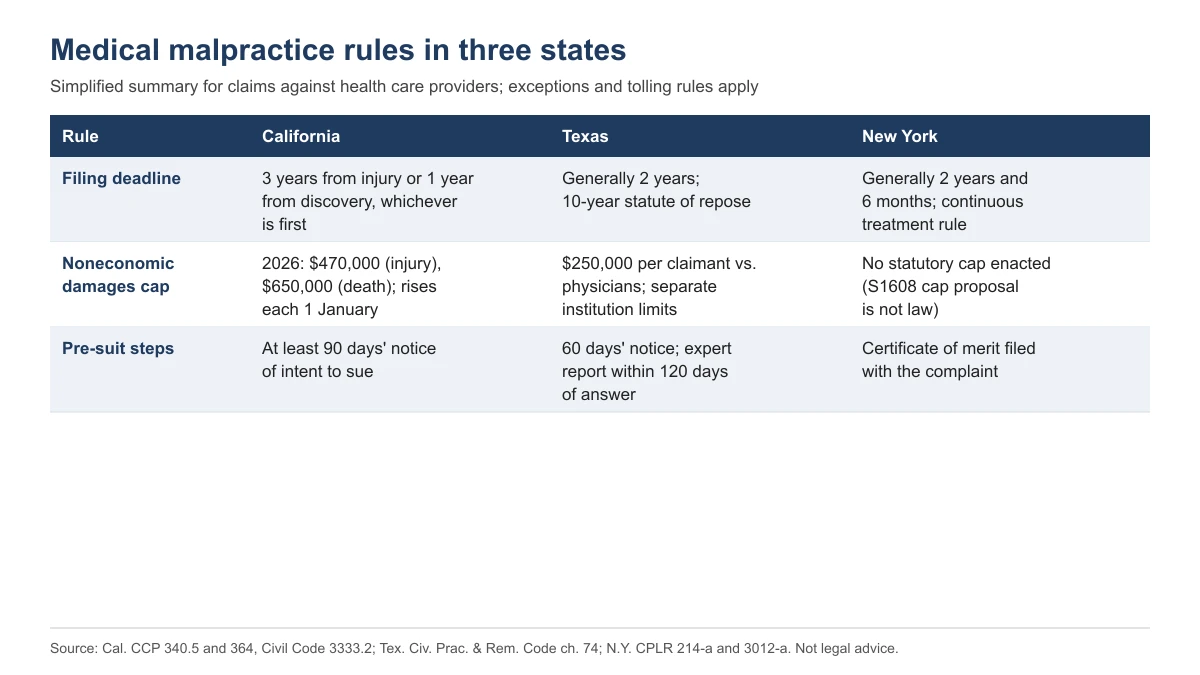
Chart: arjankc.com.np, from California Civil Code 3333.2 and Code of Civil Procedure 340.5 and 364, Texas Civil Practice and Remedies Code Chapter 74, and New York CPLR 214-a and 3012-a. Summary only; exceptions apply.
California
- Deadline: three years after the injury or one year after the patient discovers, or reasonably should have discovered, the injury, whichever occurs first. The three-year limit can be extended only for fraud, intentional concealment or a non-therapeutic foreign body (Code of Civil Procedure 340.5).
- Pre-suit notice: the defendant must be given at least 90 days’ notice of the intention to sue; notice served within the last 90 days of the limitation period extends the deadline by 90 days from service (Code of Civil Procedure 364).
- Noneconomic damages: AB 35 amended MICRA for cases filed on or after 1 January 2023. The cap started at $350,000 for injury cases and $500,000 for death cases against health care providers, and rises by $40,000 and $50,000 each 1 January for 10 years, to $750,000 and $1,000,000, with 2% annual adjustments from 2034. The amount in effect at the time of judgment, award or settlement applies (Civil Code 3333.2). Applying that schedule, the 2026 figures are $470,000 and $650,000.
Texas
- Deadline: generally two years from the breach or the completion of the treatment or hospitalization at issue, with a 10-year statute of repose (Civil Practice and Remedies Code 74.251).
- Pre-suit notice: written notice by certified mail at least 60 days before suit, with a medical authorization form (section 74.051).
- Expert report: the claimant must serve an expert report and curriculum vitae within 120 days after each defendant’s original answer (section 74.351).
- Noneconomic damages: capped at $250,000 per claimant against physicians and other non-institutional providers, plus up to $250,000 per health care institution and $500,000 for all institutions combined (section 74.301).
New York
- Deadline: generally two years and six months from the act or omission, or from the end of continuous treatment for the same condition, with a one-year discovery rule for foreign objects and a discovery rule for failure to diagnose cancer subject to a seven-year outer limit (CPLR 214-a).
- Certificate of merit: the complaint must be accompanied by the attorney’s certificate that a knowledgeable physician was consulted and that there is a reasonable basis for the action, with limited exceptions (CPLR 3012-a).
- Noneconomic damages: New York has not enacted a statutory cap. A bill in the 2025-2026 session, S1608, proposes a $250,000 limit on noneconomic damages, but it is a proposal, not law (NY Senate, S1608).
Product liability claims against a manufacturer usually follow the state’s general personal injury or product liability limitation period, which can differ from the malpractice deadline. Claims against public hospitals can carry much shorter notice deadlines.
Practical steps if you suspect a robotic surgery or AI diagnostic error
- Request your complete medical records, including operative and anesthesia records, and ask in writing whether operative video exists.
- Write down a timeline: symptoms, conversations with the care team, test results and any explanation you were given.
- Keep bills and records of lost income and later treatment.
- Do not sign releases or give recorded statements to an insurer or manufacturer before getting advice.
- Speak to a licensed attorney early, because expert review, pre-suit notices and preservation letters take time and deadlines can be short.
- Ask about every potential defendant: surgeon, hospital, manufacturer and software provider, and which deadlines apply to each.
Key takeaways
- Robotic surgery and AI diagnostic cases can involve malpractice claims against clinicians and hospitals and product liability claims against manufacturers.
- The FDA has cleared RAS devices for specific procedures, mostly through 510(k), and does not regulate or accredit surgeon training.
- Riegel v. Medtronic preempts many claims about PMA devices; 510(k)-cleared devices generally lack that protection, and parallel claims may survive.
- MAUDE reports and recalls can help investigations but do not prove causation.
- Filing deadlines, damage caps and expert requirements vary widely; California, Texas and New York show how different the rules can be.
Related guides
- Top Personal Injury Lawyers in New York: How to Choose
- Mesothelioma Lawsuit Settlements: What You Need to Know
- Truck Accident Black Box Data and Liability Claims
Sources
- US Food and Drug Administration, Computer-Assisted Surgical Systems and Robotically-Assisted Surgical Devices: Premarket Submissions (draft guidance, September 2026).
- US Food and Drug Administration, Clinical Decision Support Software guidance (January 2026) and AI-Enabled Device Software Functions draft guidance.
- US Food and Drug Administration, MAUDE database and Data Mining at the Center for Devices and Radiological Health.
- Cornell Legal Information Institute (eCFR text): 21 CFR Part 807 Subpart E, 21 CFR Part 814, 21 CFR 7.3.
- Supreme Court of the United States, Riegel v. Medtronic, Inc., 552 U.S. 312 (2008) (Cornell LII).
- Washington Supreme Court, Taylor v. Intuitive Surgical, Inc. (2017).
- California Court of Appeal, Elam v. College Park Hospital (1982); California Supreme Court, Cobbs v. Grant (1972).
- California Legislative Information, Civil Code 3333.2 and Code of Civil Procedure 340.5, Code of Civil Procedure 364 and Evidence Code 1157.
- Texas Legislature, Civil Practice and Remedies Code Chapter 74.
- New York State Senate, CPLR 214-a and CPLR 3012-a, and Senate Bill S1608 (2025-2026, proposed).
- US Food and Drug Administration, De Novo DEN190022 classification order.
- Intuitive Surgical, Statement for FDA Safety Communication (manufacturer statement on 510(k) clearances).