Mesothelioma Lawsuit Settlements: What You Need to Know
Disclaimer: This article is general information, not legal, tax or medical advice. arjankc.com.np is not a law firm and does not refer cases. Laws and deadlines differ by state and change over time. Speak to a licensed attorney in your state about your situation.
Last reviewed: 13 October 2026
A mesothelioma diagnosis brings medical decisions and, for many families, a legal question: can we get compensation from the companies responsible for the asbestos exposure? This guide explains how mesothelioma settlements work in the United States, the two main routes to compensation, what affects the amount, and the practical issues — taxes, Medicare and deadlines — that families often learn about too late.
Why mesothelioma claims exist
Mesothelioma is a rare cancer of the thin tissue lining the lungs, abdomen or heart. The CDC reports 2,669 new cases in the United States in 2022, and states that exposure to asbestos causes most cases (CDC).

Asbestos was widely used in insulation, building materials, brakes and other products during the 20th century. Because the disease appears long after exposure — the CDC’s toxic-substances agency lists a latency of 10–57 years for pleural mesothelioma, with 30–40 years typical (ATSDR) — many people diagnosed today were exposed decades ago at work, in the military or at home.

Pipe insulation made from asbestos fibres, one of the most common historical uses. Photo: User:EPO, via Wikimedia Commons (attribution licence).

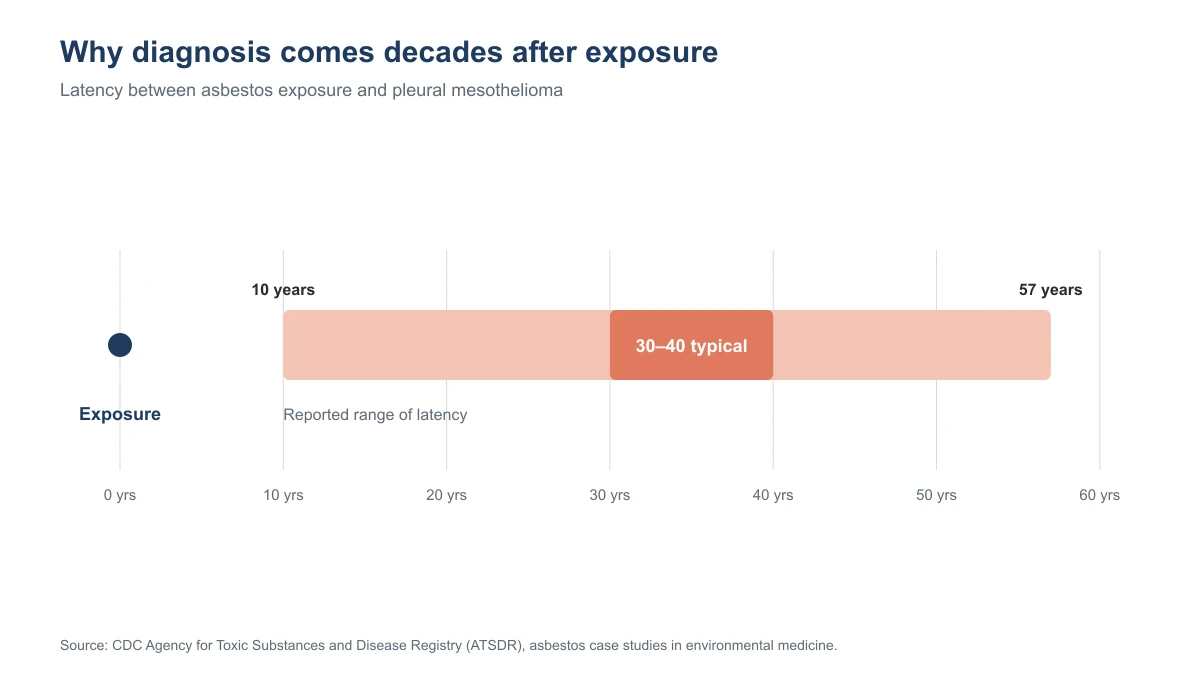
Chart: latency for pleural mesothelioma. Source: ATSDR.
Asbestos is still regulated today. In 2024 the EPA finalised a rule banning ongoing uses of chrysotile asbestos, the only form still used in or imported to the US at the time (EPA; Federal Register).
The two main routes to compensation
1. Lawsuits against solvent companies
A personal injury lawsuit (or a wrongful death lawsuit if the person has died) is brought against companies that made, sold or used asbestos products and are still in business. Most of these cases settle before trial. A settlement is a private agreement: the company pays an agreed amount and the claimant gives up the right to pursue that company further. Settlement terms are often confidential.
2. Claims against asbestos bankruptcy trusts
Many asbestos companies went bankrupt because of asbestos liability. Under the federal bankruptcy code, a company can move its asbestos liabilities and some assets into a trust that pays current and future claimants.
The US Government Accountability Office found that about 100 companies had declared bankruptcy at least partly because of asbestos liability, and that 60 trusts had been set up since 1988 with about $37 billion in total assets. From 1988 through 2010, the trusts paid about 3.3 million claims worth about $17.5 billion (GAO-11-819).
Trust claims are not lawsuits. Each trust follows its own trust distribution procedures, which set the medical and exposure evidence required and a scheduled value for each disease. Claims are usually paid as a percentage of that scheduled value, generally first-in, first-out (GAO full report).
Trusts usually offer two review paths:
- Expedited review: if the claim meets the trust’s medical and exposure criteria, it is paid at the scheduled value for that disease.
- Individual review: the trust looks at the claimant’s specific circumstances — for example dependents or pain and suffering — and the payment can be higher or lower than the expedited amount.
Because exposure often involved products from several companies, a person may file with more than one trust. RAND notes that this is why the number of claims paid is higher than the number of people compensated, and that attorneys’ fees come out of trust payments (RAND).
What affects the value of a mesothelioma settlement
There is no reliable official “average” settlement. Private settlements are often confidential, and the GAO found that trust payment information varies widely in what is made public (GAO-11-819). Be cautious with any single figure you see quoted online.
What generally shapes the value of a claim:
- Diagnosis and medical evidence. A confirmed mesothelioma diagnosis with pathology records is central. Trusts set different values for different diseases.
- Exposure evidence. Work history, employer records, Social Security earnings records, invoices and coworker testimony that show which products were involved. The GAO lists these as typical exposure evidence for trust claims.
- Number of responsible parties. More identifiable product manufacturers can mean more defendants and more trust claims.
- Economic losses. Medical bills, lost wages and lost future earnings.
- Non-economic losses. Pain and suffering and loss of companionship, where state law allows them.
- State law and venue. Rules on damages, deadlines and how fault is shared differ by state.
- Whether the claimant is living. A living person brings a personal injury claim; after death, the family or estate may bring a wrongful death claim, which can change the damages available.
How the process usually works
- Medical diagnosis and records. Gather pathology reports, imaging and treatment records.
- Exposure history. Build a detailed timeline of jobs, sites, products, military service and any household exposure.
- Choose a lawyer. Asbestos cases are specialised. Most plaintiffs’ lawyers work on a contingency fee, which under the American Bar Association’s model rules must be agreed in writing and state how the fee is calculated (ABA Model Rule 1.5).
- File trust claims and/or a lawsuit. Trust claims go to each relevant trust. Lawsuits are filed in a court with jurisdiction over the defendants.
- Discovery and negotiation. Each side exchanges evidence; many cases settle at this stage.
- Settlement or trial. If no settlement is reached, the case may go to trial.
- Liens and distribution. Medicare, other health plans and lawyers’ fees are resolved before the claimant receives the net amount.
Deadlines: the statute of limitations
Every state sets a statute of limitations — a deadline to file a lawsuit (Cornell LII). For diseases with long latency, many states apply a discovery rule, which starts the clock when the injury was discovered or reasonably should have been discovered, not when the exposure happened (Cornell LII). Wrongful death claims usually have their own deadline. Trusts set their own filing rules too. Because deadlines vary and can be short, get legal advice soon after diagnosis.
Taxes on mesothelioma settlements
Under Internal Revenue Code section 104(a)(2), damages received for personal physical injuries or physical sickness are generally excluded from income. The IRS states that if you did not deduct the related medical expenses in earlier years, the full amount of such a settlement is non-taxable; if you did, the part that reimburses those deducted expenses is taxable (IRS Publication 4345). Punitive damages and interest are taxable (IRS). Ask a tax professional how your settlement is structured.
Medicare and settlements
If Medicare paid for treatment related to the claim, those payments are “conditional” and must be repaid from a settlement, judgment or award. You or your attorney should notify Medicare’s Benefits Coordination & Recovery Center, which issues a demand letter for the amount owed (CMS). Medicare’s recovery right takes priority over most other claims on the money, including Medicaid (CMS MSP Manual). Plan for this before agreeing a settlement.
Veterans: VA benefits are separate
Asbestos was widely used by the military, and a VA-accredited claims agent interviewed by VA News describes veterans as the largest group of people diagnosed with mesothelioma (VA News). A veteran who has a condition caused by asbestos exposure during service may be eligible for tax-free monthly VA disability compensation. The VA asks for medical records, service records showing the job or specialty, and a doctor’s statement linking the condition to in-service exposure (VA; VA Compensation).
A VA claim is a benefits claim, not a lawsuit. Legal claims for asbestos exposure are generally brought against the product manufacturers and suppliers, so a veteran may pursue VA benefits and civil claims separately.
Red flags when choosing help
- Promises of a specific settlement amount before anyone has reviewed your records.
- Pressure to sign a fee agreement immediately, or a fee agreement that is not in writing.
- No clear explanation of how costs, trust claims and Medicare repayment will be handled.
- A firm that cannot say which states it is licensed in or who will actually handle your case.
Related guides
- Top Personal Injury Lawyers in New York: How to Choose
- Truck Accident Black Box Data and Liability Claims
- Robotic Surgery and AI Diagnostics Malpractice Liability
Sources
- CDC, Incidence of Malignant Mesothelioma
- ATSDR, Asbestos Toxicity: Respiratory Conditions
- US GAO, GAO-11-819: Asbestos Injury Compensation — The Role and Administration of Asbestos Trusts
- RAND, Asbestos Bankruptcy Trusts: An Overview of Trust Structure and Activity
- EPA, Final ban on ongoing uses of chrysotile asbestos (2024)
- IRS, Publication 4345: Settlements — Taxability and Tax implications of settlements and judgments
- CMS, Medicare’s Recovery Process
- US Department of Veterans Affairs, Veterans asbestos exposure
- Cornell Law School LII, Statute of limitations and Discovery rule
- American Bar Association, Model Rule 1.5: Fees