Commercial Property Insurance Bad Faith Claims Guide
Disclaimer: This article is general information, not legal or insurance advice. arjankc.com.np is not a law firm, insurer or public adjuster, does not recommend or rank specific lawyers or adjusters, and does not receive referral fees. Insurance law varies by state and by policy wording and changes over time; speak to a licensed attorney about your situation.
Last reviewed: 13 October 2026
When a fire, storm, burst pipe or break-in damages a business property, the commercial property policy is supposed to fund the repair and, if the business carries it, the lost income. Most claims are settled through normal adjusting. Some are not: the insurer delays, pays far less than the repair cost, or denies the claim on grounds the owner believes are wrong. This guide explains how commercial claims are adjusted, what “bad faith” means in insurance law, the claim-handling deadlines in three large states and the practical steps before a dispute becomes a lawsuit.
How a commercial property claim is adjusted
The policy sets the rules
A commercial property policy usually has several parts: the building and business personal property coverage, a causes-of-loss form that says which perils are covered and excluded, and often business income and extra expense coverage. Many US insurers use standard forms from ISO (Insurance Services Office), but endorsements and manuscript wording vary a lot. Before arguing about a claim, read the declarations page, the covered causes of loss, the exclusions and the loss conditions, which set out what the policyholder must do after a loss.
The policyholder’s duties after a loss
Common loss conditions require the insured to:
- give prompt notice of the loss to the insurer;
- protect the property from further damage and keep records of the cost;
- give the insurer access to inspect the property and the books and records;
- submit a signed, sworn proof of loss when requested, often within a fixed number of days after the request;
- cooperate with the investigation, which can include an examination under oath.
Missing these duties can give the insurer a defence, so meet them even when the relationship is tense.
Who adjusts the claim
The insurer assigns a company adjuster (a staff adjuster or an independent adjusting firm). On a large loss, the insurer may also hire engineers, building consultants, forensic accountants for business income and cause-and-origin experts. The policyholder can hire its own public adjuster, a state-licensed professional who prepares and negotiates the claim for the insured, usually for a percentage of the recovery. State insurance departments license both kinds of adjuster.
What counts as insurance bad faith
“Bad faith” is not one rule. It is a mix of state statutes, regulations and court decisions. Two strands matter most.
Unfair claims settlement practices
Most states have adopted some version of the National Association of Insurance Commissioners (NAIC) Unfair Claims Settlement Practices Act (Model 900). It lists practices that regulators treat as unfair when done knowingly or as a general business practice, including:
- knowingly misrepresenting relevant facts or policy provisions;
- failing to acknowledge claim communications with reasonable promptness;
- refusing to pay claims without conducting a reasonable investigation;
- not attempting in good faith to settle claims promptly and fairly once liability is reasonably clear;
- compelling policyholders to sue by offering substantially less than they ultimately recover;
- failing to affirm or deny coverage within a reasonable time after the investigation;
- failing to give a reasonable explanation of the basis for a denial or a compromise offer.
The model act itself says it does not create a private right to sue; it is enforced by the state insurance regulator. Some states nevertheless give policyholders a statutory claim, and others recognize a separate common-law claim.
First-party bad faith claims
When a business sues its own insurer, lawyers call it a first-party claim. Depending on the state, the business may bring:
- a breach of contract claim for the policy benefits owed;
- a common-law bad faith claim (in California, for example, the tort of breach of the implied covenant of good faith and fair dealing recognised in Gruenberg v. Aetna Insurance Co. (1973));
- a statutory claim, such as Texas Insurance Code Chapters 541 and 542 or Florida’s civil remedy statute.
A genuine dispute about value or coverage is not bad faith on its own. The question is usually whether the insurer had a reasonable basis for what it did and investigated fairly.
Claim-handling deadlines in three states
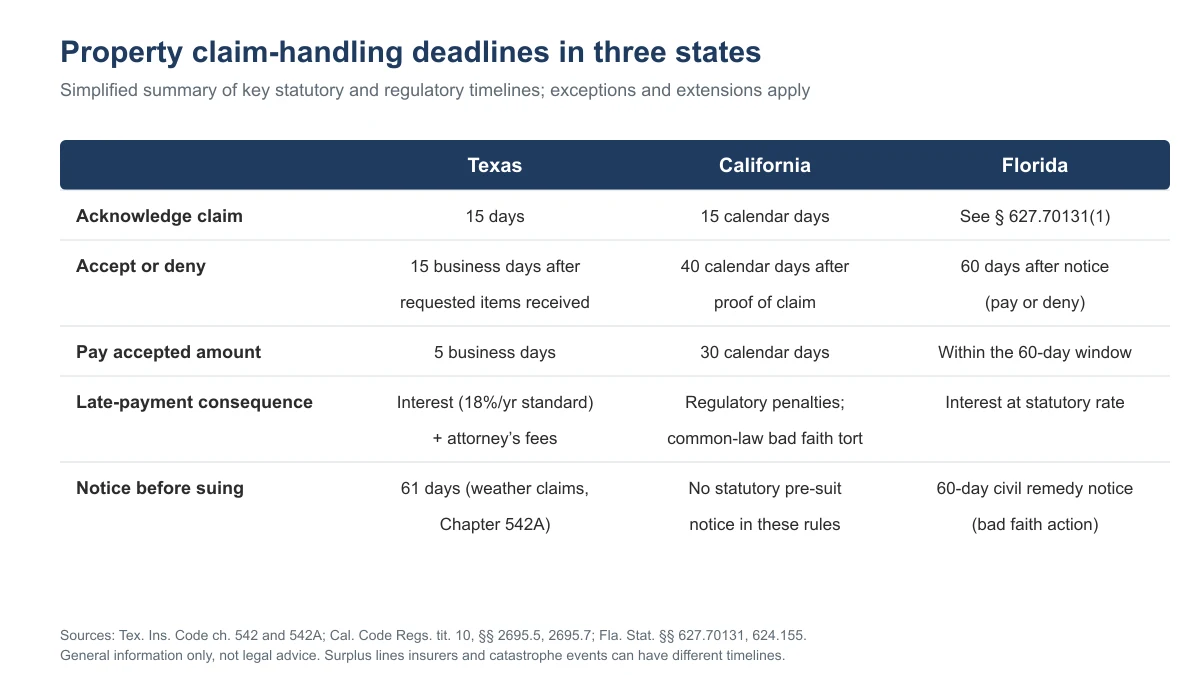
Chart: arjankc.com.np, from the Texas Insurance Code, California Code of Regulations Title 10 and Florida Statutes. Summary only; exceptions and extensions apply.
Texas
Under Texas Insurance Code Chapter 542 (prompt payment of claims), an insurer generally must:
- acknowledge the claim, begin its investigation and request the items it needs within 15 days of notice (30 business days for eligible surplus lines insurers);
- accept or reject the claim in writing within 15 business days of receiving those items, with one possible extension of up to 45 days;
- pay an accepted claim within 5 business days (20 business days for eligible surplus lines insurers).
An insurer that is liable for the claim and breaks these rules owes interest as damages plus reasonable attorney’s fees. The standard rate is 18% a year. For weather-related property claims covered by Chapter 542A, the rate is lower and tied to the judgment interest rate, and the policyholder must give written pre-suit notice at least 61 days before suing, stating the amount owed and the attorney’s fees incurred. A federal court held in 2025 that notice sent only to a third-party adjuster did not satisfy that rule, so send it to the insurer itself.
California
California Insurance Code section 790.03(h) lists unfair claims practices, and the Fair Claims Settlement Practices Regulations set the timelines. Under 10 CCR 2695.5, an insurer must acknowledge a claim and begin investigating within 15 calendar days. Under 10 CCR 2695.7, it must accept or deny the claim within 40 calendar days of proof of claim, write to explain if it needs more time, and pay accepted amounts within 30 days. Section 2695.9 adds standards specific to residential and commercial property claims. California courts have held that section 790.03 does not by itself give policyholders a private right to sue, but the common-law bad faith tort remains available.
Florida
Under Florida Statutes 627.70131, an insurer must pay or deny an initial, reopened or supplemental property claim within 60 days of notice unless factors beyond its control prevent it, and late payments carry interest. Missing that deadline alone does not create a private lawsuit. A statutory bad faith action under Florida Statutes 624.155 requires a civil remedy notice filed with the Department of Financial Services at least 60 days before suit; if the insurer pays or corrects the violation within that period, no action lies.
Appraisal, mediation and other ways to resolve a dispute
Not every disagreement needs a lawsuit. Common routes include:
- Appraisal. Many commercial policies let either party demand appraisal when they disagree on the amount of loss. Each side appoints an appraiser, the two choose an umpire, and an award agreed by any two is binding on the amount. Appraisal usually decides value, not whether the loss is covered.
- State mediation programs. Some states run mediation for certain property claims, often after declared catastrophes. Check your state insurance department.
- Regulatory complaints. A complaint to the state insurance department can prompt the insurer to review its handling and creates a record.
- Litigation. If the insurer denies coverage or the dispute is about more than value, a lawsuit for breach of contract and, where available, bad faith may be the remaining option. Policies often contain a suit limitation clause that shortens the time to sue, so check it early.
Evidence that matters in a bad faith dispute
Bad faith claims are won or lost on the claim file. Keep:
- the full policy, including every endorsement, and the declarations page for the policy period;
- the date and method of first notice, and every letter, email and call log since then;
- photos and video of the damage taken before repairs, plus repair estimates and invoices;
- the insurer’s inspection reports and estimates, and any expert reports it relied on (ask for them in writing);
- the proof of loss you submitted and the date it was received;
- financial records supporting a business income claim, such as profit and loss statements and payroll;
- a timeline showing each deadline and whether the insurer met it.
Write to the adjuster to confirm phone conversations. If the insurer’s estimate leaves out damage, respond in writing with your own estimate and ask for a written explanation of each difference.
Practical steps when a claim stalls
- Re-read the policy and list the coverages, exclusions and loss conditions that apply.
- Meet your own duties: notice, mitigation, records, proof of loss and access.
- Ask in writing for the basis of any denial or reduction, citing the policy language.
- Get independent estimates from contractors or a licensed public adjuster.
- Track statutory deadlines for your state and note each one the insurer misses.
- Consider appraisal if the only disagreement is the amount of loss.
- Speak to a licensed attorney before sending statutory notices or filing suit, especially where pre-suit notice or limitation periods apply.
Key takeaways
- Commercial property claims are governed first by the policy wording, especially the loss conditions.
- Bad faith usually means an unreasonable denial, delay or underpayment, not just a disagreement about value.
- The NAIC model act is enforced by regulators; private bad faith claims depend on each state’s statutes and case law.
- Texas, California and Florida all set claim-handling deadlines, and Texas and Florida require notice before certain lawsuits.
- A complete, dated claim file is the policyholder’s strongest evidence.
Related guides
- Truck Accident Black Box Data and Liability Claims
- How to Choose the Best Auto Insurance in California
- Top Personal Injury Lawyers in New York: How to Choose
- Robotic Surgery and AI Diagnostics Malpractice Liability
Sources
- National Association of Insurance Commissioners, Unfair Claims Settlement Practices Act (Model 900).
- Texas Legislature, Insurance Code Chapter 542: Processing and Settlement of Claims.
- Texas Legislature, Insurance Code Chapter 542A: Certain Consumer Actions Related to Claims for Property Damage.
- California Department of Insurance, Fair Claims Settlement Practices Regulations.
- Legal Information Institute, 10 CCR 2695.5 and 10 CCR 2695.7.
- The Florida Senate, Florida Statutes 627.70131 and 624.155.
- Zelle LLP, Presuit notice to third-party adjuster does not comply with section 542A.003(a), discussing Devindra Investments v. Wesco Ins. Co. (N.D. Tex. 2025).