Unit 3.1
The Internet: Technology Background
Learning Objectives
By the end of this chapter, you will be able to:
- ✅ Define the core technologies that underpin the Internet.
- ✅ Explain the process of packet switching and its role in data transmission.
- ✅ Differentiate between the functions of TCP and IP in the TCP/IP protocol suite.
- ✅ Describe the client/server computing model.
- ✅ Analyze the context of Internet adoption in Nepal.
What is the Internet? 🌐
Definition: A global network of interconnected computer networks that use the Internet protocol suite (TCP/IP) to link devices worldwide.
Think of it as a "network of networks" connecting:
- 🏢 Private & Business Networks
- 🏛️ Government Networks
- 🎓 Academic Networks
- 🏠 Public Networks
The Foundation: Packet Switching
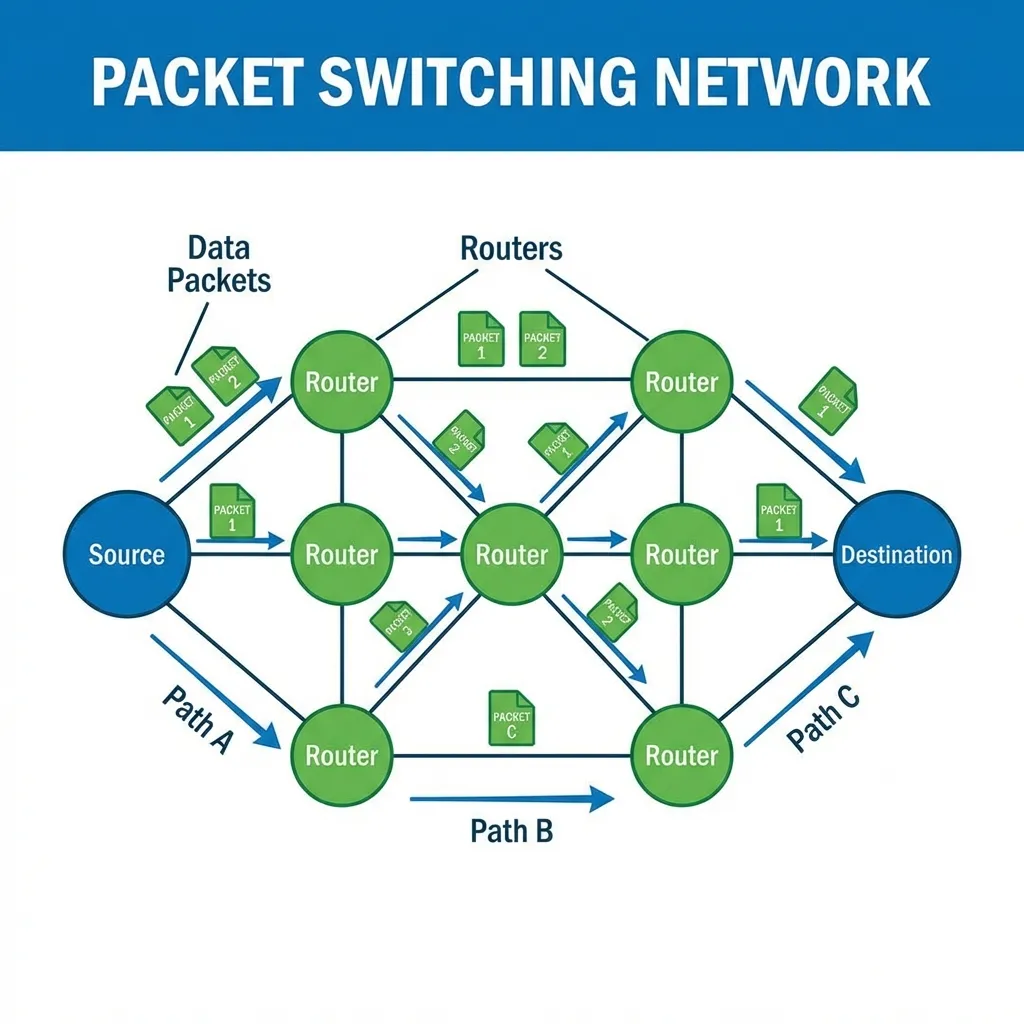
Instead of a dedicated connection, the Internet breaks data down into small pieces called packets.
Anatomy of a Packet 📦
Header
- Destination Address (IP)
- Source Address
- Packet Number
Payload
- The actual data chunk
- (e.g., part of an image, email text)
These packets travel independently across the network and are reassembled at the destination.
How Packet Switching Works ⚡
- 1. Slicing: A large file (e.g., a photo) is broken into small, numbered packets.
- 2. Addressing: Each packet's header is stamped with the destination IP address.
- 3. Routing: Packets are sent onto the network, taking different paths to the destination.
- 4. Reassembly: The destination computer collects all packets and reassembles them in the correct order.
The Language of the Internet: TCP/IP
TCP/IP (Transmission Control Protocol/Internet Protocol) is the fundamental communication protocol suite of the Internet.
It's not one protocol, but two main ones working together:
- TCP: The "Manager"
- IP: The "Postal Service"
TCP vs. IP: A Team Effort 🤝
TCP (Transmission Control Protocol)
🎯 The Reliability Manager
- Breaks data into packets before sending.
- Numbers the packets for reordering.
- Checks that all packets have arrived.
- Reassembles packets at the destination.
IP (Internet Protocol)
🗺️ The Address & Routing System
- Responsible for addressing each packet with source & destination.
- Routes the packets from one network to another.
- It's the "best effort" delivery service.
The Dominant Structure: Client/Server Computing
Client/Server Model: A distributed structure that separates tasks between service providers (servers) and service requesters (clients).
🔍 Client
- Requests information or services.
- Examples: Your web browser, email app, a mobile game.
🗄️ Server
- Provides the requested data or service.
- Examples: Web server (hosting a site), mail server, database server.
Client/Server in Action: Visiting a Website
- Client Request: Your browser (the client) sends a request for `google.com` to a DNS server.
- IP Address: The DNS server returns the IP address for Google's server.
- TCP/IP in Motion: Your browser sends an HTTP request packet (via TCP/IP) to that IP address.
- Server Response: Google's web server (the server) receives the request and sends the website data back in packets.
- Display: Your browser (client) reassembles the packets and renders the webpage.
Case Study: The Internet in Nepal 🇳🇵
The core technologies are global, but local context shapes adoption.
Challenges
- 💰 Cost: Still relatively high for a significant portion of the population.
- 🔌 Infrastructure: Underdeveloped in some rural/remote areas, leading to slower speeds.
- 📖 Digital Literacy: A barrier for some to fully utilize Internet resources.
Opportunities
- 🧑💻 Youth Population: Large, growing, and eager to adopt new technology.
- 🏛️ Government Support: Actively working to improve national infrastructure.
- 📈 Business Adoption: More businesses are using the internet for e-commerce and operations.
Nepal's Internet Market Landscape 📊
Several key players drive connectivity in the country:
Nepal Telecom
The state-owned incumbent, providing a wide range of services including mobile and fixed-line internet.
Ncell
A major private mobile network operator, a key driver of mobile broadband access across the nation.
WorldLink
One of the largest private Internet Service Providers (ISPs), especially dominant in the fiber-to-the-home (FTTH) market.
Key Point: The competition between these players is helping to drive down costs and improve service quality, accelerating internet adoption for e-commerce.
Key Takeaways
A quick review of today's core concepts:
- Packet Switching: The foundational method of breaking data into packets for efficient and robust transmission over shared networks.
- TCP/IP: The two-part protocol suite that runs the Internet. TCP manages reliable data transfer, while IP handles addressing and routing.
- Client/Server Model: The primary architecture of the web, where clients (like your browser) request resources from powerful, centralized servers.
- Local Context Matters: Global technologies are shaped by local factors like infrastructure, cost, and policy, as seen in the case of Nepal.
Thank You
Any questions?
Next Up: Unit 3.2 - Internet Infrastructure & The Web