Unit 1: Introduction to IT in Business
Definition and Scope of IT
Learning Objectives
By the end of this lecture, you will be able to:
- ✅ Define Information Technology (IT) and its core components in a business context.
- ✅ Explain the crucial role IT plays across all major business functions (Finance, HR, Operations, etc.).
- ✅ Differentiate between data, information, and business intelligence.
- ✅ Analyze the broad scope of IT, from daily operations to strategic decision-making.
Let's Start with the Basics: What is "Information"?
Data 📊
Raw, unorganized facts and figures.
- Sale Transaction: Item #101
- Quantity: 5
- Price: NPR 500
- Customer: #C892
Information 💡
Data that has been processed, organized, and structured to be meaningful.
"On October 26th, we sold 5 units of Item #101 for a total of NPR 2,500 to our regular customer, Ram."
IT's primary job is to turn raw Data into actionable Information.
Defining Information Technology (IT)
Information Technology (IT) is the use of computers, storage, networking, and other physical devices, infrastructure, and processes to create, process, store, secure, and exchange all forms of electronic data.
In simple business terms, it's the toolbox for managing information.
Hardware 💻
Physical components: Servers, PCs, Phones
Software ⚙️
Programs & Applications: OS, ERP, Excel
Networks 🌐
Connectivity: Internet, LAN, Wi-Fi
The 5 Core Components of an IT System
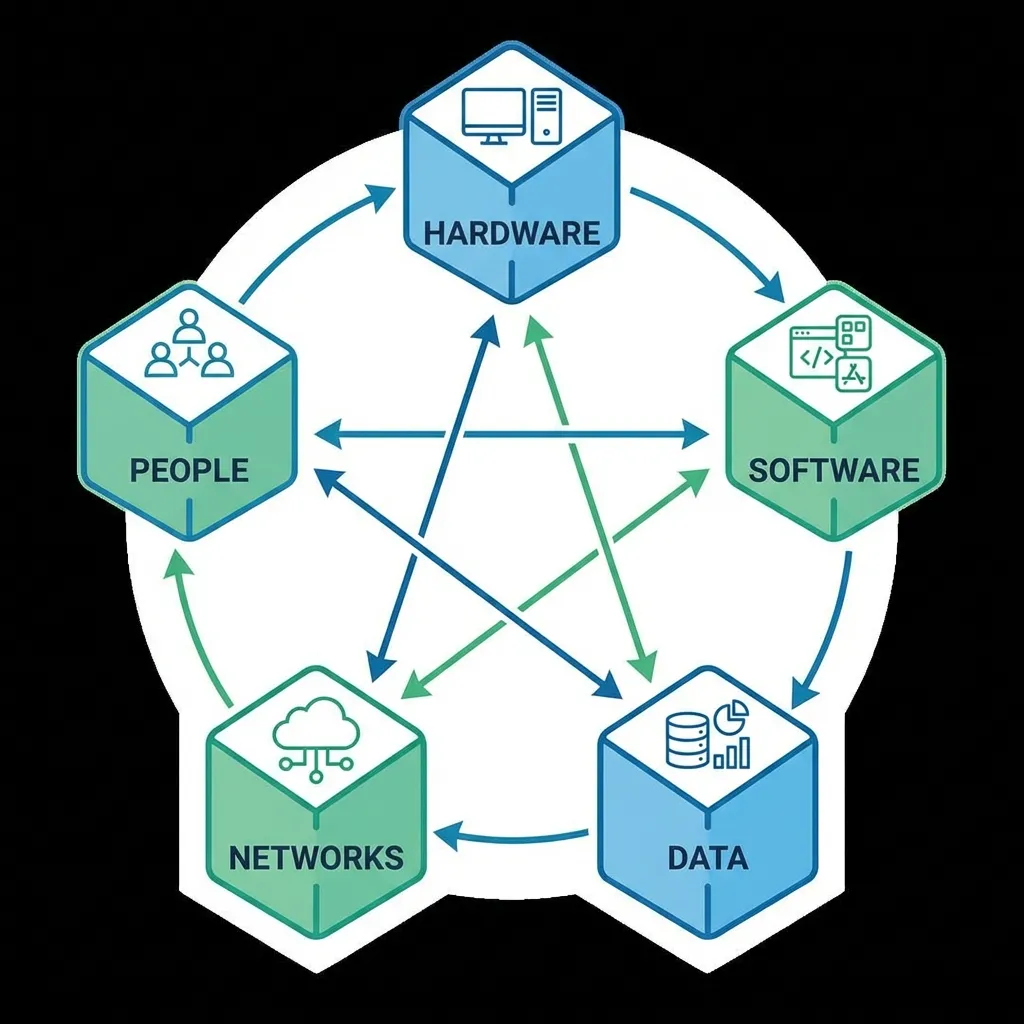
People are the most critical component. Technology is useless without skilled people to build, manage, and use it effectively.
The Broad Scope of IT in Business
IT is not a separate department; it's the nervous system of the entire organization. It connects and enables every single function.
Operational Level (Day-to-Day)
- ⚙️ Processing transactions (Point of Sale)
- 🤝 Managing employee records (HRIS)
- 📦 Tracking inventory levels
Strategic Level (Long-Term)
- 🎯 Analyzing market trends
- 🔍 Identifying new business opportunities
- ⚡ Creating competitive advantages
IT Across Business Functions: A Helicopter View
Finance & Accounting 💰
- Accounting Software (e.g., Tally)
- Financial Reporting
- Budgeting & Forecasting
- Online Payment Gateways
Human Resources 🤝
- HR Information Systems (HRIS)
- Payroll Management
- Applicant Tracking Systems (ATS)
- E-Learning & Training
Operations & Supply Chain ⚙️
- Enterprise Resource Planning (ERP)
- Inventory Management
- Logistics & Route Planning
- Quality Control Systems
Deep Dive: IT in Finance & Accounting 💰
Moving from manual ledgers to real-time financial intelligence.
- Automated Bookkeeping: Software like Tally or cloud-based systems automatically record transactions, reducing errors and saving time.
- Financial Analysis: Using spreadsheets (Excel) or specialized software to model financial scenarios, analyze investment returns, and manage cash flow.
- Compliance & Reporting: IT systems help generate legally required financial statements and tax reports quickly and accurately.
- Fraud Detection: Banks and financial institutions use algorithms to analyze transaction patterns and flag suspicious activity in real-time.
Deep Dive: IT in Operations Management ⚙️
The backbone of producing and delivering goods and services.
- Supply Chain Management (SCM): IT systems track raw materials from supplier to factory, and finished goods from factory to customer.
- Inventory Control: Barcode scanners and RFID tags provide real-time data on stock levels, preventing stockouts or overstocking. (Example: Bhat-Bhateni Supermarket)
- Enterprise Resource Planning (ERP): A single, integrated software system (like SAP or Oracle) that manages all core business processes: finance, manufacturing, HR, supply chain, etc.
- Project Management: Tools like Trello, Asana, or Jira help teams plan, execute, and monitor complex projects.
Deep Dive: IT in Human Resources 🤝
Managing the most valuable asset: People.
Scenario: A company needs to hire a new Business Analyst.
- Recruitment: Post job on MeroJob.com; use an Applicant Tracking System (ATS) to filter CVs based on keywords.
- Onboarding: New hire completes digital paperwork and mandatory online training via an e-learning platform.
- Performance: Manager tracks goals and provides feedback using a Performance Management System.
- Payroll: At the end of the month, the HRIS automatically calculates salary, tax, and benefits.
IT for Strategic Decision Making 🎯
Beyond daily tasks, IT provides insights for high-level strategy.
How it works:
BI tools (like Power BI or Tableau) connect to various data sources (sales, finance, marketing) and create interactive dashboards.
A CEO can see a real-time dashboard showing:
- Which products are most profitable?
- Which regions have the highest sales growth?
- Are we meeting our quarterly financial targets?
Practical Application: IT in Nepal 🇳🇵
IT is transforming businesses of all sizes and sectors right here.
eSewa (FinTech)
Daraz (E-commerce)
CG Foods (Manufacturing)
Summary: Key Takeaways
What are the most important ideas to remember from today's lecture?
- 1️⃣ IT is a Core Business Enabler: It's not just for 'techies'. IT is fundamental to how a modern business runs, competes, and grows.
- 2️⃣ IT Spans ALL Functions: From balancing the books in Finance to managing people in HR and making products in Operations, IT is everywhere.
- 3️⃣ IT Drives Strategic Value: The true power of IT is in its ability to convert raw data into strategic insights, giving businesses a powerful competitive advantage.
Thank You!
Any questions?
Next Topic: Role and Importance of IT in Modern Businesses