Unit 6.1
Email Campaign Planning and Tools
Learning Objectives
By the end of this chapter, you will be able to:
- ✅ Outline the key steps for planning a successful email campaign.
- ✅ Identify the core components of an effective marketing email.
- ✅ Compare popular email marketing platforms and their primary uses.
- ✅ Apply campaign planning principles to a local business scenario.
The Power of Email Marketing
Definition: A direct marketing channel that uses email to promote your business's products or services and nurture relationships with potential customers.
It's a powerful way to connect directly with an audience that has explicitly opted in to hear from you.
Key Stat ⚡: Email generates an average of $36 for every $1 spent, making it one of the highest ROI marketing channels.
The 5-Step Campaign Blueprint
A successful campaign is not an accident; it's the result of a structured process.
- Define Goals: Know your "why." What do you want to achieve? 🎯
- Build List: Grow your audience ethically.
- Design & Write: Craft a compelling message and visual experience.
- Test & Refine: Ensure quality and functionality before launch. 🔍
- Send & Analyze: Deploy the campaign and measure its performance.
We'll now break down each of these critical steps.
Step 1: Define Your Goals 🎯
Every email campaign must have a clear, measurable objective.
Common Campaign Goals
- Build Brand Awareness: Introduce your brand to new subscribers.
- Generate Leads: Capture interest with valuable content (e.g., an ebook).
- Drive Sales: Promote a new product or a limited-time offer.
- Nurture Subscribers: Build relationships and guide users through the sales funnel.
Example: A Nepali Trekking Company
Goal: Generate qualified leads for the upcoming Annapurna Base Camp trek season.
Primary KPI: Number of "Request a Custom Itinerary" form submissions from the email.
Step 2: Build Your Email List
Your list is your most valuable digital asset. Focus on quality over quantity.
The Golden Rule: Always get explicit consent (opt-in). Never buy email lists.
Effective List-Building Tactics:
- Lead Magnets: Offer a free, valuable resource (e.g., "Top 10 Packing Tips for Trekking in Nepal" PDF) in exchange for an email.
- Website Pop-ups: Use well-timed pop-ups to offer a discount or newsletter subscription.
- Contests & Giveaways: Run a social media contest where an email address is required for entry.
Step 3: Design & Write Your Email
This is where you capture attention and persuade your audience to act.
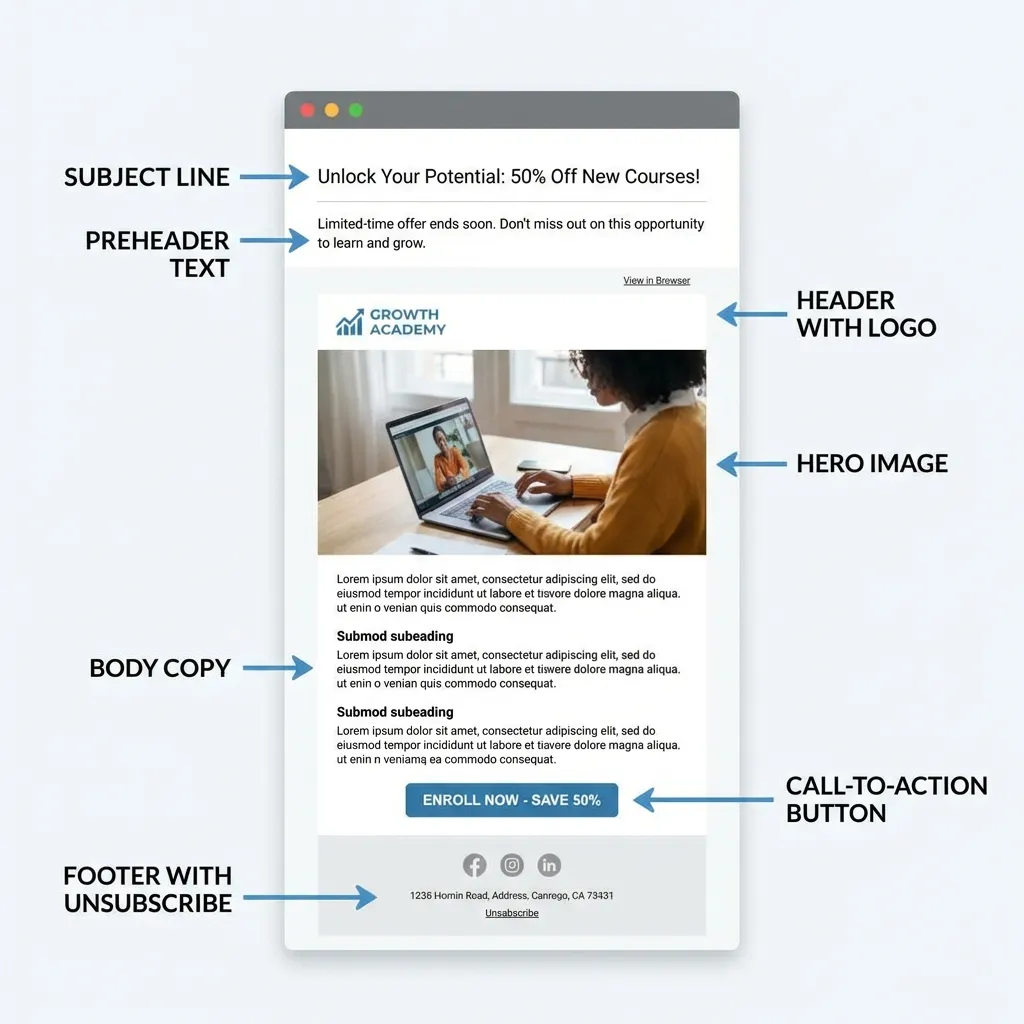
Anatomy of an Effective Email
- Compelling Subject Line: The single most important element for open rates.
- Clean, Mobile-First Design: Most emails are opened on mobile. Design accordingly.
- High-Quality Visuals: Use on-brand images or graphics that support the message.
- Persuasive Copy: Focus on benefits, not just features. Use personalization (e.g., `[First Name]`).
- Clear Call-to-Action (CTA): A prominent button with action-oriented text.
Step 4: Test, Test, Test! 🔍
Sending an email with a broken link or a typo can damage your brand's credibility.
Pre-Launch Checklist
- ✅ Proofread Everything: Check subject line, body copy, and headlines for errors.
- ✅ Test All Links: Click every single link to ensure it goes to the correct destination.
- ✅ Check Rendering: Use a tool (like Litmus or Email on Acid) or send tests to see how it looks on different devices (iPhone, Android) and clients (Gmail, Outlook).
- ✅ Verify Personalization: Ensure dynamic tags like `[First Name]` are populating correctly.
Email Marketing Tools 📊
Email Service Providers (ESPs) are the platforms that make professional email marketing possible.
They provide the infrastructure to manage lists, create emails, automate workflows, and track performance analytics.
Popular Tools: A Comparison
Mailchimp
Known For: Ease of use, great for beginners.
- Intuitive drag-and-drop editor
- Generous free plan for new businesses
- Excellent for newsletters and simple campaigns
Constant Contact
Known For: Strong support, event marketing.
- Wide range of templates
- Integrations for event management & social media
- Highly rated customer support
HubSpot
Known For: All-in-one marketing platform.
- Combines email with CRM and marketing automation
- Powerful for lead nurturing and complex workflows
- Higher price point, best for growing businesses
Practical Application: Nepal Context
Scenario: A Handicraft Store in Patan Durbar Square
Objective: Drive online sales to tourists after they've returned home.
- Goal: Achieve a 5% conversion rate from a post-visit email campaign.
- List Building: Offer a free postcard in-store in exchange for an email address and consent.
- Email Design: Use beautiful, high-resolution photos of singing bowls, pashminas, and thangkas. Keep the design elegant and simple.
- Copy & CTA: Subject: "A Piece of Nepal, Delivered to Your Door". The CTA button reads "Shop Our Collection".
- Tool: Mailchimp is a perfect, cost-effective choice for this small business to start and manage its list.
Summary & Key Takeaways
- Successful email marketing is built on a structured 5-step plan: Goals, List, Design/Copy, Test, and Send.
- Ethical list building is non-negotiable. Always prioritize consent and quality.
- The combination of a great subject line, compelling copy, and a clear CTA is what drives action.
- Always test your emails across multiple devices and clients before sending to your main list.
- Choose an Email Service Provider (ESP) that aligns with your technical skills, business goals, and budget.
Thank You
Questions?
Next Up: 6.2 - Email Automation & Drip Campaigns